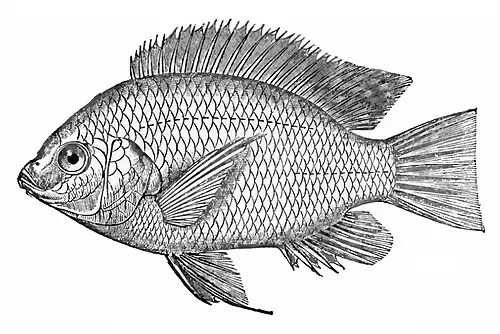
 📸 Photo
Photo: W H Flower · Public domain · Wikimedia Commons Source
Nile tilapia
Oreochromis niloticus (Nile tilapia · ティラピア)
💡 Everyday Comparisons for Size, Mass & Speed
- 💡 Its maximum weight of 4.3 kg is close to the weight of three 1.5 L plastic bottles (Comparison).
- 💡 It has spread to many countries around the world as a farmed fish and is a target of commercial fisheries (FishBase).
- 💡 It was imported from Thailand in 1955, and breeding has been confirmed in the Nakdong River mainstream, Geumhogang River, and Hwanggujicheon Stream (National List of Species of Korea).
Reference standards: coach bus ~12 m, mid-size car ~4.9 m, compact car ~1 t, basketball hoop 3.05 m, credit card 8.56 cm.
Site-computed relative index from recorded values; not a formal scientific metric.
📖 1. Overview
The Nile tilapia is a freshwater fish native to Africa that has been introduced to many countries for aquaculture. In Korea, it is also called 'minmuldom' (Korean name, meaning freshwater seabream).
🦴 2. Anatomy & Morphology
Its body is streamlined, deep, and strongly compressed from side to side, with 8–10 dark vertical bars extending to the tail over a silvery-white or dark blue background. It has two lateral lines, and the margin of its caudal fin is nearly straight.
🔍 3. Ecology & Behavior
It feeds mainly on phytoplankton or benthic algae and also eats insect larvae, with juveniles being more omnivorous than adults. The female broods the eggs in her mouth until they hatch.
🇰🇷 4. Connection to Korea
According to the National List of Species of Korea, it was imported from Thailand in 1955 and stocked into rivers and reservoirs; although low water temperatures reduced its numbers, breeding has been confirmed in the Nakdong River mainstream, Geumhogang River, and Hwanggujicheon Stream.
📚 Sources & References
- • IUCN Red List LC (2023) — https://www.iucnredlist.org/species/166975/244856058
- • IUCN Red List category LC — latest assessment at iucnredlist.org
- • catalogueoflife.org — 6SSRC
- • iucnredlist.org — 244856058
- • 국가생물종목록(국립생물자원관) ktsn 120000058724 — https://species.nibr.go.kr/home/mainHome.do?cont_link=009&subMenu=009002&contCd=009002&ktsn=120000058724
- • wikidata.org — Q311170
- • commons.wikimedia.org — File:ChromisNiloticus.jpg
- • fishbase.se — Oreochromis-niloticus.html
- • species.nibr.go.kr — mainHome.do
- • Silhouette: PhyloPic — Ingo Braasch · CC0 1.0
Recorded dimensions are widely cited representative estimates from public literature and may vary by study or specimen.