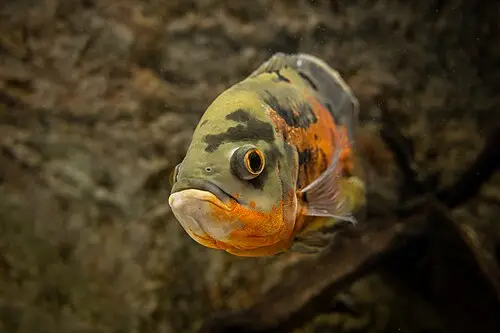
 📸 Photo
Photo: Mattia Nocciola · CC BY-SA 4.0 · Wikimedia Commons Source
Oscar
Astronotus ocellatus (Oscar · アストロノータス)
💡 Everyday Comparisons for Size, Mass & Speed
- 💡 Its average length of 30–40 cm is slightly longer than the long side of an A4 sheet of paper (29.7 cm) (Comparison).
- 💡 Its average weight of 1.58 kg is similar to a 1.5 L plastic bottle (Comparison).
- 💡 It is a prized food fish in South America and a popular aquarium fish around the world (FishBase, Animal Diversity Web).
Reference standards: coach bus ~12 m, mid-size car ~4.9 m, compact car ~1 t, basketball hoop 3.05 m, credit card 8.56 cm.
Site-computed relative index from recorded values; not a formal scientific metric.
📖 1. Overview
The Oscar is a freshwater cichlid fish living in shallow, calm waters of the Amazon and Orinoco basins in South America. It is popular worldwide as an aquarium fish.
🦴 2. Anatomy & Morphology
Wild-type individuals have a dark greenish-brown body with orange, red, and yellow markings on the sides, and a black eyespot outlined in orange and red at the base of the dorsal fin. They have thick, fleshy lips and pharyngeal jaws (throat teeth) in the throat.
🔍 3. Ecology & Behavior
It mainly feeds on the bottom, eating snails, shrimp, insects, clams, and organic matter in the mud. Males and females form pairs and reach maturity at around 14 months of age.
🇰🇷 4. Connection to Korea
No direct record connecting this species to Korea has been found.
📚 Sources & References
- • IUCN Red List LC (2023) — https://www.iucnredlist.org/species/49830436/159048790
- • IUCN Red List category LC — latest assessment at iucnredlist.org
- • catalogueoflife.org — J4RT
- • iucnredlist.org — 159048790
- • wikidata.org — Q3442
- • commons.wikimedia.org — File:Astronotus ocellatus Natural History Museum University
- • fishbase.se — Astronotus-ocellatus.html
- • animaldiversity.org — Astronotus ocellatus
- • Silhouette: PhyloPic — author not recorded · CC0 1.0
Recorded dimensions are widely cited representative estimates from public literature and may vary by study or specimen.