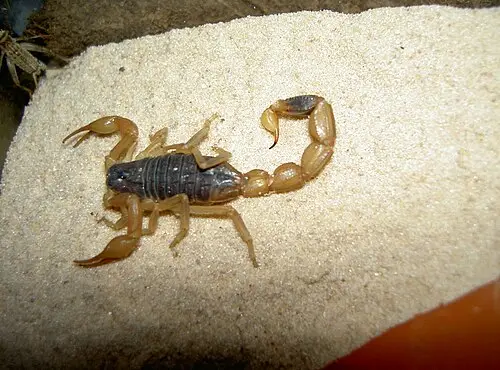
 📸 Photo
Photo: Já · CC BY-SA 3.0 · Wikimedia Commons Source
Chinese scorpion
Olivierus martensii (Chinese scorpion · Chinese scorpion)
Not Evaluated (NE) on the IUCN Red List yet.
💡 Everyday Comparisons for Size, Mass & Speed
- 💡 A maximum weight of 1.7 g is just over 1/3 the weight of a Korean 100-won coin (about 5.4 g) (Comparison).
- 💡 Individuals collected from 21 locations in eastern China were kept in a laboratory for over 3 months to compare metabolism in a scientific study (Journal of Experimental Biology).
Reference standards: coach bus ~12 m, mid-size car ~4.9 m, compact car ~1 t, basketball hoop 3.05 m, credit card 8.56 cm.
Site-computed relative index from recorded values; not a formal scientific metric.
📖 1. Overview
The Chinese scorpion (Mesobuthus martensii) is a scorpion in the family Buthidae endemic to East Asia that lives on the ground.
🦴 2. Anatomy & Morphology
The body mass of 189 measured individuals was 0.22–1.70 g. It is a ground-dwelling scorpion known for enhanced osmoregulatory ability.
🔍 3. Ecology & Behavior
It diverged from Mesobuthus caucasicus in the Late Miocene and adapted to the humid climate of East Asia about 2.37 million years ago. Studies show that the resting metabolic rate of populations across 21 sites in eastern China varies with environmental conditions.
🇰🇷 4. Connection to Korea
No direct record connecting this species to Korea has been found.
📚 Sources & References
- • IUCN Red List: not evaluated (NE) — cross-checked with the Wikidata conservation-status entry
- • catalogueoflife.org — 498SL
- • commons.wikimedia.org — File:Mesobuthus martensii (283).jpg
- • pmc.ncbi.nlm.nih.gov — PMC6602336
- • Silhouette: PhyloPic — Christoph Schomburg · CC0 1.0 (Related taxon silhouette — Centruroides)
Recorded dimensions are widely cited representative estimates from public literature and may vary by study or specimen.