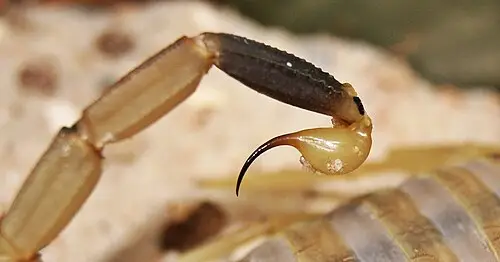
 📸 Photo
Photo: Danny S. · CC BY-SA 4.0 · Wikimedia Commons Source
Deathstalker
Leiurus quinquestriatus (Deathstalker · オブトサソリ)
Not Evaluated (NE) on the IUCN Red List yet.
💡 Everyday Comparisons for Size, Mass & Speed
- 💡 A body length of 11 cm is about 1.3 times the long side of a credit card (8.56 cm) (Comparison).
- 💡 Chlorotoxin obtained from its venom is used in cancer research, and other venom components are studied for diabetes treatment (Animal Diversity Web).
Reference standards: coach bus ~12 m, mid-size car ~4.9 m, compact car ~1 t, basketball hoop 3.05 m, credit card 8.56 cm.
Site-computed relative index from recorded values; not a formal scientific metric.
📖 1. Overview
The deathstalker is a large, highly venomous scorpion living in the deserts of North Africa and the Middle East, with a yellow body and brown spots.
🦴 2. Anatomy & Morphology
Its body length is 80–110 mm and its weight is 1–2.5 g. It has a yellow body with brown spots on the last tail segment and elsewhere, 2 eyes on the top of the head, and 2–5 additional pairs on the front corners.
🔍 3. Ecology & Behavior
Active at night, it detects small insects, spiders, centipedes, earthworms, and other scorpions through touch and vibration and crushes them with its large pincers. The gestation period is 122–277 days (average 185 days).
🇰🇷 4. Connection to Korea
No direct record connecting this species to Korea has been found.
📚 Sources & References
- • IUCN Red List: not evaluated (NE) — cross-checked with the Wikidata conservation-status entry
- • catalogueoflife.org — 6P78R
- • wikidata.org — Q773744
- • animaldiversity.org — Leiurus quinquestriatus
- • Silhouette: PhyloPic — Nicolas Mouquet · CC0 1.0 (Congeneric silhouette — Abalistes stellaris)
Recorded dimensions are widely cited representative estimates from public literature and may vary by study or specimen.