 📸 Photo
Photo: Alan Eng from Brussels, Belgium · CC BY 2.0 · Wikimedia Commons Source
Okapi
Okapia johnstoni (Okapi · オカピ)
💡 Everyday Comparisons for Size, Mass & Speed
- 💡 Because of its resemblance to horses and zebras it was first placed in the genus Equus, before later being shown to be closest to giraffes after its discovery in the Congo region in 1901.
- 💡 Extending its tongue more than 12 inches (about 30 cm) is similar to the long side of an A4 sheet of paper (29.7 cm) (Comparison).
- 💡 A maximum weight of 350 kg is about seventeen 20 kg bags of rice (Comparison).
Reference standards: coach bus ~12 m, mid-size car ~4.9 m, compact car ~1 t, basketball hoop 3.05 m, credit card 8.56 cm.
Site-computed relative index from recorded values; not a formal scientific metric.
📖 1. Overview
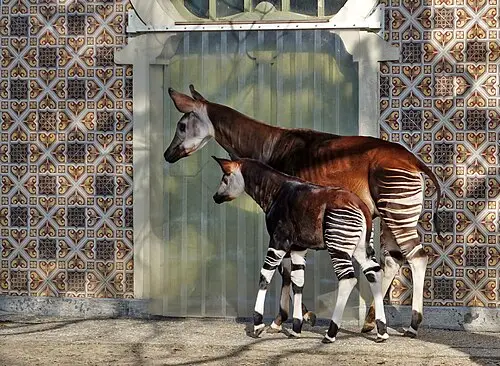
The Okapi is a close relative of the giraffe found only in the forests of the Democratic Republic of the Congo, marked with zebra-like stripes on its legs.
🦴 2. Anatomy & Morphology
Its coat is a velvety dark reddish-brown with white stripes on the legs. Its black tongue extends more than 12 inches (about 30 cm), and only males have short, skin-covered horns.
🔍 3. Ecology & Behavior
It eats the buds, leaves, and twigs of more than 100 plant species, as well as sulfur-rich clay. Its gestation period is long, averaging about 440 days, and females usually give birth to a single calf.
🇰🇷 4. Connection to Korea
No direct record connecting this species to Korea has been found.
📚 Sources & References
- • IUCN Red List EN (2015) — https://www.iucnredlist.org/species/15188/51140517
- • IUCN Red List category EN — latest assessment at iucnredlist.org
- • mammaldiversity.org — 1006343
- • iucnredlist.org — 51140517
- • wikidata.org — Q82037
- • commons.wikimedia.org — File:Okapi and son.jpg
- • animaldiversity.org — Okapia johnstoni
- • Silhouette: PhyloPic — T. Michael Keesey · CC0 1.0
Recorded dimensions are widely cited representative estimates from public literature and may vary by study or specimen.