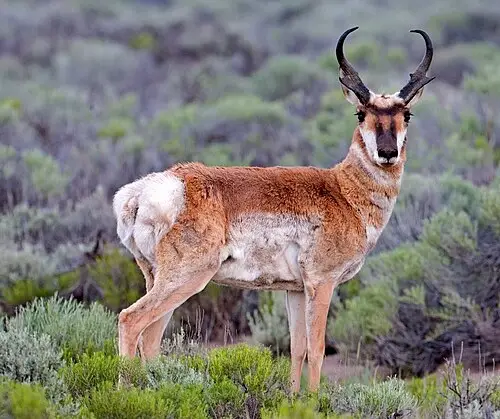
 📸 Photo
Photo: www.naturespicsonline.com · CC BY-SA 3.0 · Wikimedia Commons Source
Pronghorn
Antilocapra americana (Pronghorn · プロングホーン)
💡 Everyday Comparisons for Size, Mass & Speed
- 💡 It is an important big-game species in the western United States, and because it lives in open country, hunter success rates can reach 90 percent (Animal Diversity Web).
- 💡 Human-made barriers such as fences, roads, and railways block its movements and reduce its numbers (Animal Diversity Web).
- 💡 Its maximum weight of 70 kg equals three and a half 20 kg bags of rice (Comparison).
Reference standards: coach bus ~12 m, mid-size car ~4.9 m, compact car ~1 t, basketball hoop 3.05 m, credit card 8.56 cm.
Site-computed relative index from recorded values; not a formal scientific metric.
📖 1. Overview
The pronghorn is a small ungulate living in the open grasslands and sagebrush scrub of western North America.
🦴 2. Anatomy & Morphology
It has a barrel-shaped body and coarse, hollow hair filled with air that provides excellent insulation. Its back is covered in reddish-brown fur.
🔍 3. Ecology & Behavior
It is a ruminant that selectively nibbles small amounts of sagebrush, forbs, grasses, and cacti. It gathers into large herds in winter and disperses in spring, with males defending territories from March to early October.
🇰🇷 4. Connection to Korea
No direct record connecting this species to Korea has been found.
📚 Sources & References
- • IUCN Red List LC (2016) — https://www.iucnredlist.org/species/1677/115056938
- • IUCN Red List category LC — latest assessment at iucnredlist.org
- • mammaldiversity.org — 1006129
- • iucnredlist.org — 115056938
- • wikidata.org — Q187943
- • commons.wikimedia.org — File:Antilocapra americana.jpg
- • animaldiversity.org — Antilocapra americana
- • Silhouette: PhyloPic — Margot Michaud · CC0 1.0
Recorded dimensions are widely cited representative estimates from public literature and may vary by study or specimen.