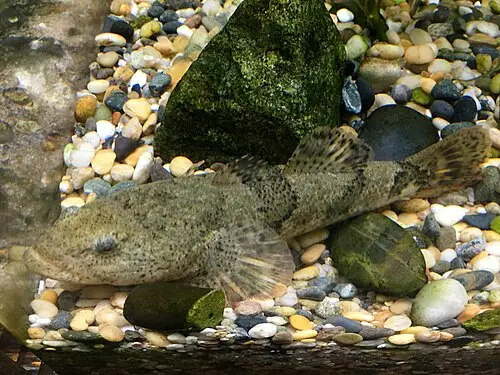
 📸 Photo
Photo: Lofor · CC BY-SA 4.0 · Wikimedia Commons Source
Korean dark sleeper
Odontobutis platycephala (Korean dark sleeper · Korean dark sleeper)
Not Evaluated (NE) on the IUCN Red List yet.
💡 Everyday Comparisons for Size, Mass & Speed
- 💡 Its maximum body length of 20.2 cm is similar to the short side of an A4 sheet of paper (21 cm) (Comparison).
- 💡 Because it is an endemic species living in rivers across almost all of Korea, the undersides of stones and hollowed sandy bottoms in nearby streams are its home.
Reference standards: coach bus ~12 m, mid-size car ~4.9 m, compact car ~1 t, basketball hoop 3.05 m, credit card 8.56 cm.
📖 1. Overview
The Korean dark sleeper is a flat-headed freshwater fish endemic to Korea that lives under stones in Korean rivers.
🦴 2. Anatomy & Morphology
Its body is elongated and cylindrical, becoming laterally compressed toward the rear. Its head is flattened from top to bottom, its mouth is large with the lower jaw longer than the upper jaw, and it lacks a lateral line.
🔍 3. Ecology & Behavior
Adults live mainly in pools rather than riffles, staying under stones or in hollowed sandy bottoms to feed on aquatic insects and small fish. The male attaches eggs to the underside of a stone and guards them until they hatch.
🇰🇷 4. Connection to Korea
The National List of Species of Korea states that it is a Korean endemic species living in rivers across almost the entire country except rivers in Gangwon-do flowing into the East Sea.
📚 Sources & References
- • IUCN Red List: not evaluated (NE) — cross-checked with the Wikidata conservation-status entry
- • catalogueoflife.org — 48P6K
- • 국가생물종목록(국립생물자원관) ktsn 120000058980 — https://species.nibr.go.kr/home/mainHome.do?cont_link=009&subMenu=009002&contCd=009002&ktsn=120000058980
- • wikidata.org — Q5237797
- • commons.wikimedia.org — File:Odontobutis platycephala COEX1.jpg
- • fishbase.se — Odontobutis-platycephala.html
- • species.nibr.go.kr — list
- • Silhouette: PhyloPic — author not recorded · CC0 1.0 (Congeneric silhouette — Odontobutis obscura)
Recorded dimensions are widely cited representative estimates from public literature and may vary by study or specimen.