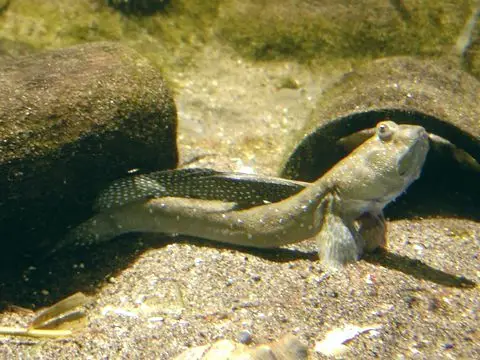
 📸 Photo
Photo: ふうけ · Public domain · Wikimedia Commons Source
Great blue spotted mudskipper
Boleophthalmus pectinirostris (Great blue spotted mudskipper · ムツゴロウ)
💡 Everyday Comparisons for Size, Mass & Speed
- 💡 A female's maximum length of 22 cm is almost the same as the short side of an A4 sheet of paper (21 cm) (Comparison).
- 💡 According to the National List of Species of Korea, it can be seen on mudflats of the West and South seas, and according to FishBase, it is caught for food and also used in traditional medicine in China.
Reference standards: coach bus ~12 m, mid-size car ~4.9 m, compact car ~1 t, basketball hoop 3.05 m, credit card 8.56 cm.
Site-computed relative index from recorded values; not a formal scientific metric.
📖 1. Overview
The Great blue spotted mudskipper is a goby that lives on mudflats and can breathe air to move around out of water. Its body is bluish with scattered white spots.
🦴 2. Anatomy & Morphology
Its head is large and flattened from top to bottom, while its body is slender and long. Cobalt-blue spots are scattered over its blue body, and its second dorsal fin has 6 horizontal rows of large white spots.
🔍 3. Ecology & Behavior
At low tide, it crawls across the mudflat to feed on diatoms, and at high tide, it hides inside its burrow. Its spawning season is from June to August.
🇰🇷 4. Connection to Korea
The National List of Species of Korea records that it lives in the South Sea and West Sea of Korea.
📚 Sources & References
- • IUCN Red List VU (2025) — https://www.iucnredlist.org/species/241148837/241148840
- • IUCN Red List category VU — latest assessment at iucnredlist.org
- • catalogueoflife.org — 5WMTZ
- • iucnredlist.org — 241148840
- • 국가생물종목록(국립생물자원관) ktsn 120000059006 — https://species.nibr.go.kr/home/mainHome.do?cont_link=009&subMenu=009002&contCd=009002&ktsn=120000059006
- • wikidata.org — Q1186232
- • commons.wikimedia.org — File:Mutsugoroh0809.jpg
- • fishbase.se — Boleophthalmus-pectinirostris.html
- • species.nibr.go.kr — mainHome.do
- • Silhouette: PhyloPic — Luan Rabelo · Public Domain Mark 1.0 (Congeneric silhouette — Boleophthalmus dussumieri)
Recorded dimensions are widely cited representative estimates from public literature and may vary by study or specimen.