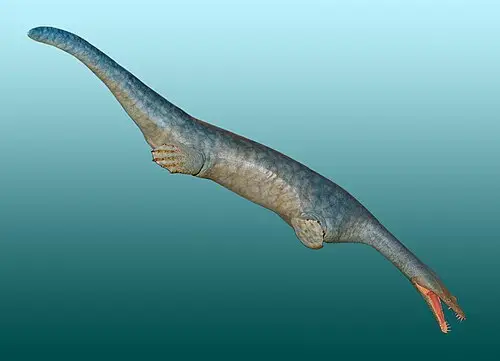
 🎨 Restoration
Restoration: Model created by Adam Procházka , Baden-Baden, Germany for Staatliches Museum für Naturkunde Karlsruhe, Germany. Foto: H. Zell · CC BY-SA 3.0 · Wikimedia Commons Source
Life restorations are artistic reconstructions based on fossil evidence; true coloration and soft-tissue details remain uncertain.
Nothosaurus
Nothosaurus mirabilis (Nothosaurus · Nothosaurus)
Known only from fossils. The IUCN Red List assesses only species extant since 1500 CE, so fossil taxa are not assigned a category.
💡 Everyday Comparisons for Size, Mass & Speed
- 💡 Its estimated body length of 3.2 m is about 2/3 the length of a standard parking space (about 5 m) (Comparison).
- 💡 This specimen began when a quarry worker near Bayreuth, Germany brought in a rock slab with bone fragments in March 1834, and a 2022 paper redescribed it in detail as part of the museum collection in Bayreuth, Germany.
Reference standards: coach bus ~12 m, mid-size car ~4.9 m, compact car ~1 t, basketball hoop 3.05 m, credit card 8.56 cm.
📖 1. Overview
Nothosaurus mirabilis (genus Nothosaurus) was a marine reptile that lived in Middle Triassic seas and belonged to Sauropterygia, the group related to plesiosaurs. The holotype specimen of this species came from a quarry near Bayreuth, Germany.
🦴 2. Anatomy & Morphology
The holotype preserves an articulated series of neck and anterior trunk vertebrae, while the skull and shoulder bones are missing. Because the neural spines of the vertebrae were very tall and the humerus was broad like a wing, it is thought to have swum by undulating its trunk when moving fast and rowing with its forelimbs when moving slowly.
🔍 3. Fossil Record & Paleoecology
Researchers interpret its slender jaws with prominent front fangs as an adaptation for feeding mainly on fish. The holotype was found in a condition suggesting it may have been scavenged by a large predator before burial.
🇰🇷 4. Connection to Korea
No direct record connecting this species to Korea has been found.
📚 Sources & References
- • Fossil taxon — the IUCN Red List assesses only species living or extinct since 1500
- • paleobiodb.org — basicTaxonInfo
- • wikidata.org — Q127001146
- • commons.wikimedia.org — File:Skeleton Nothosauria naturkundemuseum Berlin.jpg
- • pmc.ncbi.nlm.nih.gov — PMC9422981
- • Silhouette: PhyloPic — author not recorded · CC0 1.0
Recorded dimensions are widely cited representative estimates from public literature and may vary by study or specimen.