 📸 Photo
Photo: Susan Ellis, Bugwood.org · CC BY 3.0 us · Wikimedia Commons Source
Greater Bulldog Bat
Noctilio leporinus (Greater Bulldog Bat · ウオクイコウモリ)
💡 Everyday Comparisons for Size, Mass & Speed
- 💡 It has been observed hunting in the late afternoon near pelicans, presumably catching small fish startled by the birds.
- 💡 A maximum weight of 78 g is slightly heavier than a chicken egg (about 60 g) (Comparison).
- 💡 A maximum head-body length of 13.2 cm is slightly shorter than a ballpoint pen (about 14 cm) (Comparison).
Reference standards: coach bus ~12 m, mid-size car ~4.9 m, compact car ~1 t, basketball hoop 3.05 m, credit card 8.56 cm.
Site-computed relative index from recorded values; not a formal scientific metric.
📖 1. Overview
The Greater Bulldog Bat is one of the few fish-eating bat species and lives close to water.
🦴 2. Anatomy & Morphology
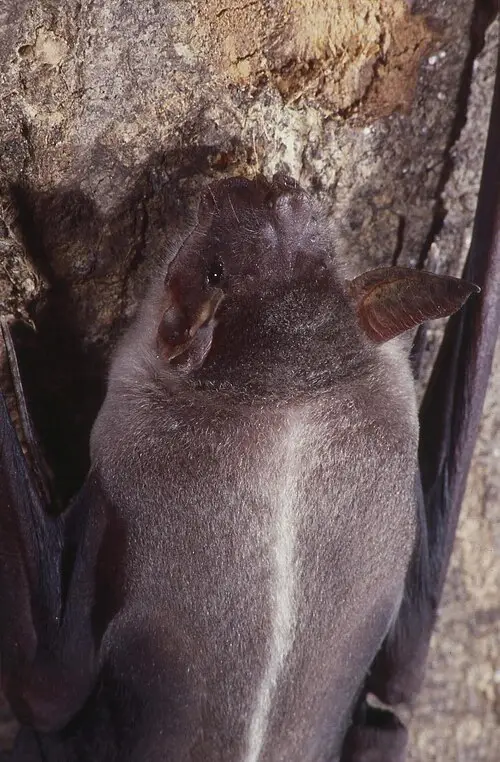
It measures 98–132 mm in head-body length with a 70–92 mm forearm. Males are reddish-orange while females are gray to dull brown, its upper lip is split like a hare lip, and its fur is very short.
🔍 3. Ecology & Behavior
Foraging in groups of 5–15 at dusk and night, it flies 20–50 cm above ponds, rivers, and ocean surf while using echolocation to detect fish. It also eats crustaceans and insects, and females give birth to one young at a time.
🇰🇷 4. Connection to Korea
No direct record connecting this species to Korea has been found.
📚 Sources & References
- • IUCN Red List LC (2015) — https://www.iucnredlist.org/species/14830/22019554
- • IUCN Red List category LC — latest assessment at iucnredlist.org
- • mammaldiversity.org — 1004871
- • iucnredlist.org — 22019554
- • wikidata.org — Q1073474
- • commons.wikimedia.org — File:Captive Noctilio leporinus.jpg
- • animaldiversity.org — Noctilio leporinus
- • Silhouette: PhyloPic — Natalie Kestel · CC BY 4.0
Recorded dimensions are widely cited representative estimates from public literature and may vary by study or specimen.