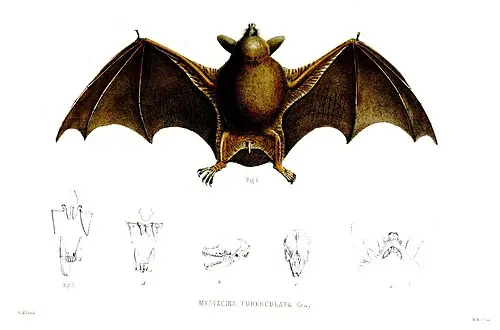
 📸 Photo
Photo: GH Ford · Public domain · Wikimedia Commons Source
Lesser New Zealand Short-tailed Bat
Mystacina tuberculata (Lesser New Zealand Short-tailed Bat · ツギホコウモリ)
💡 Everyday Comparisons for Size, Mass & Speed
- 💡 Folding its wings to use like forelegs resembles the way a rodent walks and burrows with its front legs (Comparison).
- 💡 An average weight of 23.5 g is just over four Korean 100-won coins (about 5.4 g each) (Comparison).
- 💡 A maximum head-body length of 8 cm is slightly shorter than the long side of a credit card (about 8.6 cm) (Comparison).
Reference standards: coach bus ~12 m, mid-size car ~4.9 m, compact car ~1 t, basketball hoop 3.05 m, credit card 8.56 cm.
Site-computed relative index from recorded values; not a formal scientific metric.
📖 1. Overview
The Lesser New Zealand Short-tailed Bat is an unusual bat that folds its wings to use like forelegs while crawling on the ground.
🦴 2. Anatomy & Morphology
It measures 6–8 cm in head-body length with a 40–45 mm forearm, and its fur is thicker than that of other bats. Its thick, leathery wing membranes can be rolled up, and basal talons on its thumb and toe claws are suited for ground life and tree climbing.
🔍 3. Ecology & Behavior
It is an omnivore that eats fruit, nectar, pollen, arthropods such as insects, and even carrion. It uses its teeth to burrow roosting cavities in trees and underground, and a single young is born at any time between spring and autumn.
🇰🇷 4. Connection to Korea
No direct record connecting this species to Korea has been found.
📚 Sources & References
- • IUCN Red List VU (2021) — https://www.iucnredlist.org/species/14261/22070543
- • IUCN Red List category VU — latest assessment at iucnredlist.org
- • mammaldiversity.org — 1004869
- • iucnredlist.org — 22070543
- • wikidata.org — Q955340
- • commons.wikimedia.org — File:MystacinaTuberculataFord.jpg
- • animaldiversity.org — Mystacina tuberculata
Recorded dimensions are widely cited representative estimates from public literature and may vary by study or specimen.