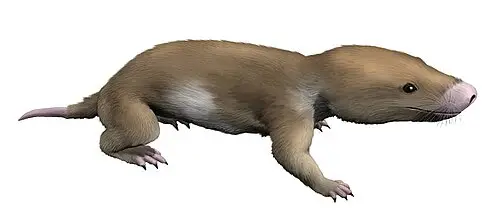
 🎨 Restoration
Restoration: Nobu Tamura ( http://spinops.blogspot.ca/ ) · CC BY-SA 4.0 · Wikimedia Commons Source
Life restorations are artistic reconstructions based on fossil evidence; true coloration and soft-tissue details remain uncertain.
Morganucodon
Morganucodon watsoni (Morganucodon · Morganucodon)
Known only from fossils. The IUCN Red List assesses only species extant since 1500 CE, so fossil taxa are not assigned a category.
💡 Everyday Comparisons for Size, Mass & Speed
- 💡 National Museum Cardiff (National Museum Wales) introduces a precisely reconstructed model nicknamed 'Morgie' on display in its gallery.
- 💡 About 70 years after the genus was first discovered in a Welsh quarry (as of a 2018 museum article), its fossils are still being used in research that digitally reassembles bone fragments using X-ray scans.
Reference standards: coach bus ~12 m, mid-size car ~4.9 m, compact car ~1 t, basketball hoop 3.05 m, credit card 8.56 cm.
📖 1. Overview
Morganucodon watsoni (genus Morganucodon) belonged to a group of tiny early mammals from the Early Jurassic; its name means 'Glamorgan tooth,' after the Welsh region. Numerous teeth and jawbones have been found in fissure-fill deposits at quarries in South Wales.
🦴 2. Anatomy & Morphology
It is reconstructed as a small, furry animal resembling a shrew. Based on studies of its teeth, the museum explains that some early mammals were able to chew insects with hard wing covers.
🔍 3. Fossil Record & Paleoecology
It may have rested in rock crevices or caves and possibly hibernated during cold seasons. Studies of cementum growth lines in its teeth showed that it lived longer than modern mammals of similar size and had a metabolic rate closer to that of reptiles.
🇰🇷 4. Connection to Korea
No direct record connecting this species to Korea has been found.
📚 Sources & References
- • Fossil taxon — the IUCN Red List assesses only species living or extinct since 1500
- • paleobiodb.org — basicTaxonInfo
- • wikidata.org — Q20718778
- • museum.wales — Meet-Morgie
- • palass.org — article pp1139-1156
- • europepmc.org — 33046697
- • Silhouette: PhyloPic — author not recorded · CC0 1.0
Recorded dimensions are widely cited representative estimates from public literature and may vary by study or specimen.