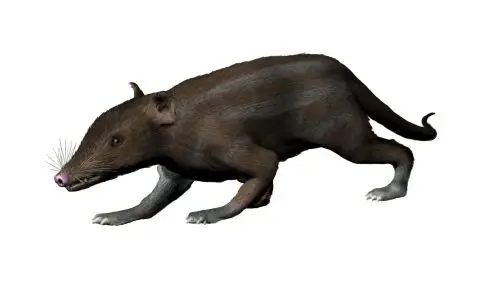
 🎨 Restoration
Restoration: Nobu Tamura http://paleoexhibit.blogspot.com/ http://spinops.blogspot.com/ http://www.palaeocritti.com · CC BY-SA 3.0 · Wikimedia Commons Source
Life restorations are artistic reconstructions based on fossil evidence; true coloration and soft-tissue details remain uncertain.
Juramaia
Juramaia sinensis (Juramaia · Juramaia)
Known only from fossils. The IUCN Red List assesses only species extant since 1500 CE, so fossil taxa are not assigned a category.
💡 Everyday Comparisons for Size, Mass & Speed
- 💡 Almost all mammals around us, such as humans, dogs, and cats, are placental mammals, and Juramaia is introduced as the oldest fossil of the eutherian group to which placentals belong.
- 💡 Because the record of their first appearance was pushed back by about 35 million years, the previous record stood at about 125 million years ago (calculated as 160 − 35).
Reference standards: coach bus ~12 m, mid-size car ~4.9 m, compact car ~1 t, basketball hoop 3.05 m, credit card 8.56 cm.
📖 1. Overview
Juramaia sinensis (genus Juramaia) was a small mammal found in Jurassic strata of China dating to about 160 million years ago and was reported as the oldest fossil among eutherians, the group that includes placental mammals. This discovery pushed back the first appearance of eutherians by about 35 million years compared with previous records.
🦴 2. Anatomy & Morphology
Its forelimbs have features well suited for climbing trees (scansorial). Several parts of its body, including its teeth, show the ancestral features of eutherians.
🔍 3. Fossil Record & Paleoecology
Judging from the structure of its forelimbs, it is interpreted to have lived by climbing up and down trees or rocks. This fossil narrowed the gap between the fossil record and the divergence time of placentals and marsupials estimated from molecular data.
🇰🇷 4. Connection to Korea
No direct record connecting this species to Korea has been found.
📚 Sources & References
- • Fossil taxon — the IUCN Red List assesses only species living or extinct since 1500
- • paleobiodb.org — basicTaxonInfo
- • wikidata.org — Q134529
- • commons.wikimedia.org — File:Juramaia NT.jpg
- • europepmc.org — 21866158
Recorded dimensions are widely cited representative estimates from public literature and may vary by study or specimen.