 📸 Photo
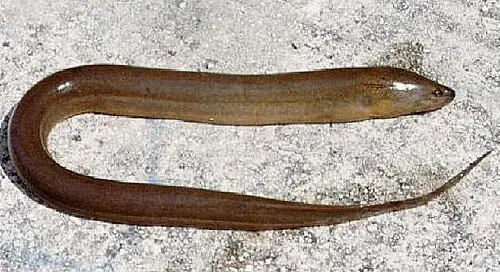
Photo: Leo G. Nico, USGS, Gainesville, FL · Public domain · Wikimedia Commons Source
Asian swamp eel
Monopterus albus (Asian swamp eel · タウナギ)
💡 Everyday Comparisons for Size, Mass & Speed
- 💡 Spending its entire life in rice paddies, lakes, and rivers, it is a fish found in nearby waters such as irrigation canals and paddy edges.
- 💡 Its body length of about 60 cm is about twice the long side of an A4 sheet of paper (29.7 cm) (Comparison).
Reference standards: coach bus ~12 m, mid-size car ~4.9 m, compact car ~1 t, basketball hoop 3.05 m, credit card 8.56 cm.
📖 1. Overview
The Asian swamp eel is an eel-like freshwater fish around 60 cm long that lives in the muddy bottoms of rice paddies, irrigation canals, and reservoirs.
🦴 2. Anatomy & Morphology
Its body is slender, elongated, and cylindrical, with almost no scales or fins and only a vestigial caudal fin remaining. It breathes air.
🔍 3. Ecology & Behavior
It hides in mud or rock crevices during the day and preys on fish and small aquatic insects at night. As it grows, it changes sex from female to male; its spawning season is June–July, when it digs a burrow in mud to lay eggs that the male guards.
🇰🇷 4. Connection to Korea
The National List of Species of Korea states that it lives in lower reaches of rivers flowing into the West and South Seas, as well as in reservoirs and irrigation canals on Baengnyeongdo and Geojedo Islands.
📚 Sources & References
- • IUCN Red List LC (2021) — https://www.iucnredlist.org/species/166148/162163341
- • IUCN Red List category LC — latest assessment at iucnredlist.org
- • catalogueoflife.org — 4495D
- • iucnredlist.org — 162163341
- • 국가생물종목록(국립생물자원관) ktsn 120000058045 — https://species.nibr.go.kr/home/mainHome.do?cont_link=009&subMenu=009002&contCd=009002&ktsn=120000058045
- • wikidata.org — Q1336863
- • commons.wikimedia.org — File:Monopterus albus 2.jpg
- • species.nibr.go.kr — list
- • fishbase.se — Monopterus-albus.html
- • Silhouette: PhyloPic — Grupo de Ictiología de la Universidad de Antioquia · CC BY 4.0 (Related taxon silhouette — Synbranchus marmoratus)
Recorded dimensions are widely cited representative estimates from public literature and may vary by study or specimen.