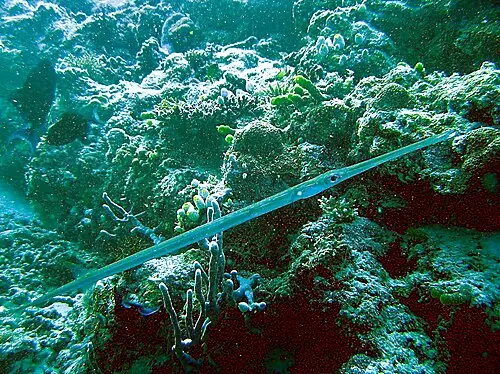
 📸 Photo
Photo: Matthias Kleine --> Mkleine · CC BY-SA 3.0 · Wikimedia Commons Source
Bluespotted cornetfish
Fistularia commersonii (Bluespotted cornetfish · アオヤガラ)
💡 Everyday Comparisons for Size, Mass & Speed
- 💡 Its maximum length of 1.6 m is just shy of an adult human height (about 1.7 m) (Comparison).
- 💡 According to the National List of Species of Korea, it has been recorded in Pohang in Korea, and FishBase notes that it is caught on a small commercial scale and traded as an aquarium fish.
Reference standards: coach bus ~12 m, mid-size car ~4.9 m, compact car ~1 t, basketball hoop 3.05 m, credit card 8.56 cm.
📖 1. Overview
The Bluespotted cornetfish is a marine fish with a rod-like elongated body and a pipe-like snout. It is widespread across warm seas worldwide outside the Atlantic Ocean.
🦴 2. Anatomy & Morphology
Its body is a long, cylindrical rod shape and its snout is shaped like a long tube. It has no scales, bony plates along its lateral line, and two middle rays of its tail fin extending out like long threads.
🔍 3. Ecology & Behavior
It lives alone or in schools and feeds on small fishes, shrimps, and squid. When threatened, it holds its body upright to disguise itself as seaweed, and its spawning season is from June to August.
🇰🇷 4. Connection to Korea
The National List of Species of Korea records it as living in Pohang.
📚 Sources & References
- • IUCN Red List LC (2016) — https://www.iucnredlist.org/species/18257780/115368874
- • IUCN Red List category LC — latest assessment at iucnredlist.org
- • catalogueoflife.org — 6J77G
- • iucnredlist.org — 115368874
- • 국가생물종목록(국립생물자원관) ktsn 120000058037 — https://species.nibr.go.kr/home/mainHome.do?cont_link=009&subMenu=009002&contCd=009002&ktsn=120000058037
- • wikidata.org — Q671948
- • commons.wikimedia.org — File:Fistularia commersonii1.jpg
- • fishbase.se — Fistularia-commersonii.html
- • species.nibr.go.kr — mainHome.do
- • Silhouette: PhyloPic — K. M. Cantalice and J. Alvarado-Ortega (modified) · CC BY 4.0 (Congeneric silhouette — Fistularia)
Recorded dimensions are widely cited representative estimates from public literature and may vary by study or specimen.