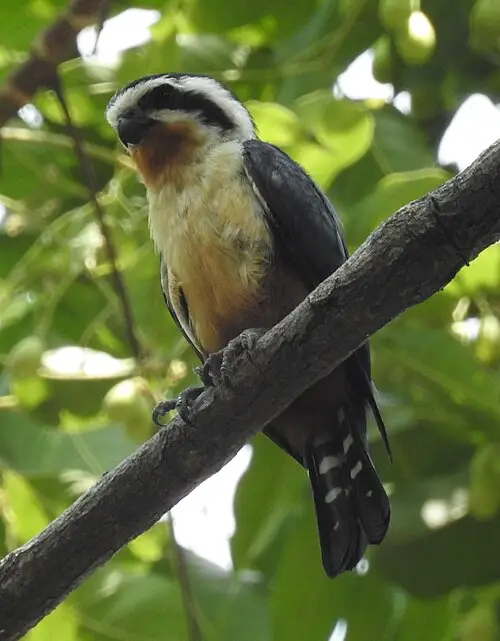
 📸 Photo
Photo: Dr. Raju Kasambe · CC BY-SA 4.0 · Wikimedia Commons Source
Collared Falconet
Microhierax caerulescens (Collared Falconet · モモアカヒメハヤブサ)
💡 Everyday Comparisons for Size, Mass & Speed
- 💡 Nest holes recorded in India's Corbett National Park had a diameter of about 6.5 cm, barely large enough for a tennis ball (about 6.7 cm in diameter) to fit.
- 💡 Because it is a raptor small enough to be confused with a sparrow, it is hard to spot when perched in the forest.
- 💡 In a 2000 survey at India's Buxa Tiger Reserve, 65% of 84 recorded prey items were insects, especially butterflies.
Reference standards: coach bus ~12 m, mid-size car ~4.9 m, compact car ~1 t, basketball hoop 3.05 m, credit card 8.56 cm.
📖 1. Overview
The Collared Falconet is a tiny bird of prey found from the Himalayan foothills of India to Southeast Asia. It flies out from branches at forest edges and clearings to catch insects.
🦴 2. Anatomy & Morphology
It is so small that it is sometimes mistaken for a small songbird like a sparrow. Females are larger, have a more distinct rufous collar patch and darker underparts, and repeatedly bob their tails up and down while perched.
🔍 3. Ecology & Behavior
It hunts mainly large insects, especially butterflies, and also catches birds, lizards, and small mammals. It sallies from branches to snatch prey in midair, is seen in pairs or groups of 4–6, and nests in high tree cavities previously used by barbets.
🇰🇷 4. Connection to Korea
No direct record connecting this species to Korea has been found.
📚 Sources & References
- • IUCN Red List LC (2024) — https://www.iucnredlist.org/species/22696324/264006772
- • IUCN Red List category LC — latest assessment at iucnredlist.org
- • doi.org — avilist.v2026
- • iucnredlist.org — 264006772
- • wikidata.org — Q754987
- • commons.wikimedia.org — File:Collared Falconet Microhierax caerulescens by Dr. Raju
- • zenodo.org — 13682582
- • zenodo.org — 16112629
- • zenodo.org — content
- • zenodo.org — content
- • Silhouette: PhyloPic — Unknown (photo), John E. McCormack, Michael G. Harvey, Brant C. Faircloth, Nicholas G. Crawford, Travis C. Glenn, Robb T. Brumfield & T. Michael Keesey · CC BY 3.0 (Related taxon silhouette — Micrastur semitorquatus)
Recorded dimensions are widely cited representative estimates from public literature and may vary by study or specimen.