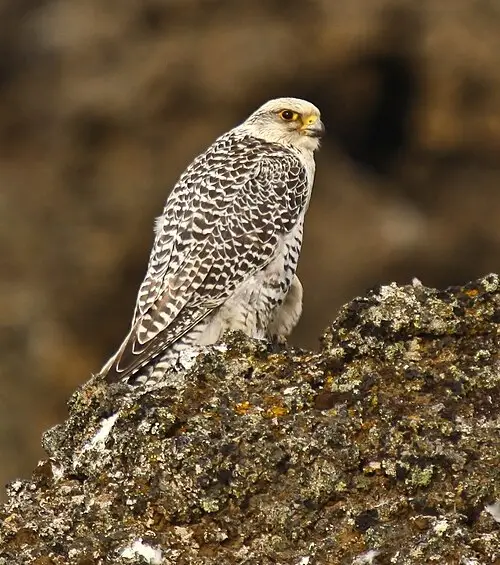
 📸 Photo
Photo: Falco_rusticolus_white.jpg : Ólafur Larsen derivative work: Bogbumper ( talk ) · CC BY-SA 2.0 · Wikimedia Commons Source
Gyrfalcon
Falco rusticolus (Gyrfalcon · シロハヤブサ)
💡 Everyday Comparisons for Size, Mass & Speed
- 💡 Its maximum weight of 2.1 kg is slightly heavier than a 2 L bottle of water (Comparison).
- 💡 Falconry is one of the oldest sports, dating back about 4,000 years, and the white-morph Gyrfalcon was historically hunted only by royalty and regarded as the "bird of kings" (ADW "Economic Importance for Humans: Positive").
- 💡 In the Middle East, high demand for falconry has made illegal capture and black-market trade a problem (ADW).
Reference standards: coach bus ~12 m, mid-size car ~4.9 m, compact car ~1 t, basketball hoop 3.05 m, credit card 8.56 cm.
Site-computed relative index from recorded values; not a formal scientific metric.
📖 1. Overview
The Gyrfalcon is the largest falcon in the world, breeding mainly in the Arctic tundra of high northern latitudes. Its plumage is divided into three color morphs: white, gray, and dark.
🦴 2. Anatomy & Morphology
The white morph is nearly pure white with markings mainly on the wings, the gray morph shows two tones of gray on the body, and the dark morph is nearly black. Because of the large size difference between sexes, body weight spans a wide range (males 800–1,300 g).
🔍 3. Ecology & Behavior
Using raw power, it pursues prey in tail chases and feeds most heavily on ptarmigans (Lagopus sp.), Arctic ground squirrels (Spermophilus parryii), and Arctic hares (Lepus arcticus). It is mostly resident, making short movements in winter to areas with prey.
🇰🇷 4. Connection to Korea
It is listed under the name "Huin-mae" (Korean name) in the National List of Species of Korea.
📚 Sources & References
- • IUCN Red List LC (2021) — https://www.iucnredlist.org/species/22696500/206261845
- • IUCN Red List category LC — latest assessment at iucnredlist.org
- • doi.org — avilist.v2026
- • iucnredlist.org — 206261845
- • 국가생물종목록(국립생물자원관) ktsn 120000001577 — https://species.nibr.go.kr/home/mainHome.do?cont_link=009&subMenu=009002&contCd=009002&ktsn=120000001577
- • wikidata.org — Q177688
- • commons.wikimedia.org — File:Falco rusticolus white cropped.jpg
- • animaldiversity.org — Falco rusticolus
- • Silhouette: PhyloPic — Andy Wilson · CC0 1.0
Recorded dimensions are widely cited representative estimates from public literature and may vary by study or specimen.