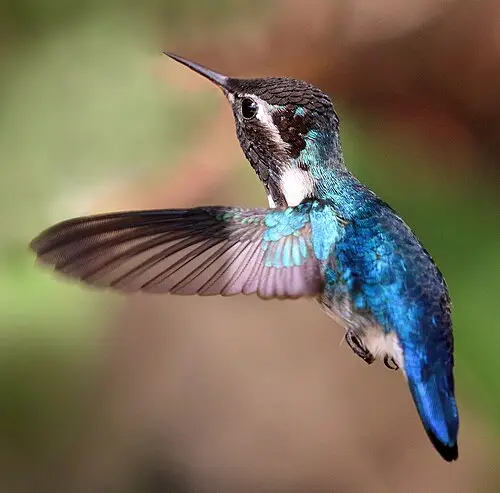
 📸 Photo
Photo: Charles J. Sharp · CC BY-SA 4.0 · Wikimedia Commons Source
Bee Hummingbird
Mellisuga helenae (Bee Hummingbird · マメハチドリ)
💡 Everyday Comparisons for Size, Mass & Speed
- 💡 Planting hummingbird flowers or hanging sugar-water feeders can attract it to gardens, and it also helps pollinate crops (ADW).
- 💡 Its average weight of about 2.3 g is less than half that of a 100-won coin (about 5.4 g).
Reference standards: coach bus ~12 m, mid-size car ~4.9 m, compact car ~1 t, basketball hoop 3.05 m, credit card 8.56 cm.
Site-computed relative index from recorded values; not a formal scientific metric.
📖 1. Overview
The Bee Hummingbird is the smallest bird in the world and is endemic to Cuba. About the size of a large bee, it spends much of its life in flight.
🦴 2. Anatomy & Morphology
Its body is compact and streamlined, with flight muscles making up 22–34% of its body weight. Its shoulder joints allow the wings to rotate 180 degrees, and its tiny feet and legs are used only for perching.
🔍 3. Ecology & Behavior
Hovering in front of flowers, it sips nectar with its long, extensible tongue and also picks insects and spiders from blossoms with its bill. Because of its rapid metabolism, it spends up to 15% of the day feeding.
🇰🇷 4. Connection to Korea
No direct record connecting this species to Korea has been found.
📚 Sources & References
- • IUCN Red List NT (2021) — https://www.iucnredlist.org/species/22688214/178593744
- • IUCN Red List category NT — latest assessment at iucnredlist.org
- • doi.org — avilist.v2026
- • iucnredlist.org — 178593744
- • wikidata.org — Q213036
- • commons.wikimedia.org — File:Bee hummingbird (Mellisuga helenae) adult male in fligh
- • animaldiversity.org — Mellisuga helenae
- • Silhouette: PhyloPic — Steven Traver · CC0 1.0
Recorded dimensions are widely cited representative estimates from public literature and may vary by study or specimen.