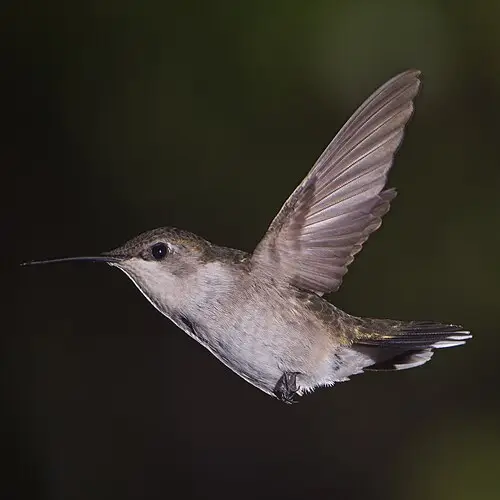
 📸 Photo
Photo: Pslawinski · CC BY-SA 4.0 · Wikimedia Commons Source
Ruby-throated Hummingbird
Archilochus colubris (Ruby-throated Hummingbird · ノドアカハチドリ)
💡 Everyday Comparisons for Size, Mass & Speed
- 💡 Its weight of about 3.8 g is lighter than a 100-won coin (about 5.4 g), and its 9 cm length is half that of a spoon (about 18 cm).
- 💡 It visits backyard sugar-water feeders and expends so much energy that it can drink half its body weight in a single day (Smithsonian National Zoo).
Reference standards: coach bus ~12 m, mid-size car ~4.9 m, compact car ~1 t, basketball hoop 3.05 m, credit card 8.56 cm.
Site-computed relative index from recorded values; not a formal scientific metric.
📖 1. Overview
The Ruby-throated Hummingbird is a tiny hummingbird that breeds in eastern North America and winters in Central America, feeding on floral nectar and frequently visiting parks and backyard gardens.
🦴 2. Anatomy & Morphology
The crown and back are metallic green and the belly is white; males have an iridescent ruby-red throat and a forked tail, whereas females have a pale grayish throat and a blunt, white-tipped tail.
🔍 3. Ecology & Behavior
It feeds on nectar and small insects, taking tree sap when nectar is scarce, and hovers in midair while lapping nectar with its long tongue. Males defend territories, while females care for the eggs and young alone.
🇰🇷 4. Connection to Korea
No direct record connecting this species to Korea has been found.
📚 Sources & References
- • IUCN Red List LC (2021) — https://www.iucnredlist.org/species/22688193/186910664
- • IUCN Red List category LC — latest assessment at iucnredlist.org
- • doi.org — avilist.v2026
- • iucnredlist.org — 186910664
- • wikidata.org — Q834843
- • commons.wikimedia.org — File:Female Ruby Throated Hummingbird.jpg
- • animaldiversity.org — Archilochus colubris
- • nationalzoo.si.edu — ruby-throated-hummingbird
- • Silhouette: PhyloPic — Andy Wilson · CC0 1.0
Recorded dimensions are widely cited representative estimates from public literature and may vary by study or specimen.