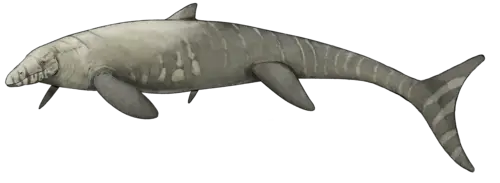
 🎨 Restoration
Restoration: SeismicShrimp · CC0 · Wikimedia Commons Source
Life restorations are artistic reconstructions based on fossil evidence; true coloration and soft-tissue details remain uncertain.
Megapterygius
Megapterygius wakayamaensis (Megapterygius · Megapterygius)
Known only from fossils. The IUCN Red List assesses only species extant since 1500 CE, so fossil taxa are not assigned a category.
💡 Everyday Comparisons for Size, Mass & Speed
- 💡 A body length of about 6 m is about one and 1/3 passenger cars (about 4.5 m) (Comparison). A University of Cincinnati press release compared its size to that of a great white shark.
- 💡 Wakayama Prefecture gave it the nickname 'Wakayama Soryu' so residents could feel close to it, and Aridagawa Town promotes the town with a life-sized 3D-printed model.
Reference standards: coach bus ~12 m, mid-size car ~4.9 m, compact car ~1 t, basketball hoop 3.05 m, credit card 8.56 cm.
📖 1. Overview
Megapterygius wakayamaensis (commonly known as the 'Wakayama Soryu') was a mosasaurid marine reptile that lived in the seas of Japan during the Late Cretaceous. Discovered in Aridagawa Town, Wakayama Prefecture in 2006 and described as a new genus and species in 2023, it is the first nearly complete mosasaur skeleton found in Asia.
🦴 2. Anatomy & Morphology
It had unusually large paddle-like flippers relative to its body, with hind flippers longer than its skull. Other notable features include forward-facing eyes providing binocular vision and neural spines on the vertebrae suggesting a possible dorsal fin.
🔍 3. Fossil Record & Paleoecology
Researchers explain that its tail fin likely allowed rapid acceleration to hunt fish. Following its discovery in 2006, about 10 years of excavation and preparation revealed almost the entire skeleton except for the tail tip.
🇰🇷 4. Connection to Korea
No direct record connecting this species to Korea has been found.
📚 Sources & References
- • Fossil taxon — the IUCN Red List assesses only species living or extinct since 1500
- • paleobiodb.org — basicTaxonInfo
- • wikidata.org — Q124482422
- • commons.wikimedia.org — File:Megapterygius wakayamaensis.png
- • pref.wakayama.lg.jp — index.html
- • pref.wakayama.lg.jp — d00215304.html
- • uc.edu — uc-paleontologist-describes-wakayama-blue-dragon-that-ruled-
- • doi.org — 14772019.2023.2277921
- • Silhouette: PhyloPic — Cy Marchant · CC BY 4.0
Recorded dimensions are widely cited representative estimates from public literature and may vary by study or specimen.