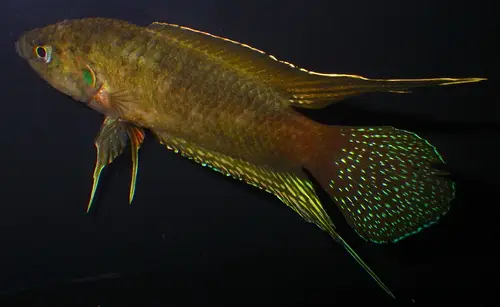
 📸 Photo
Photo: Andrew Bogott · CC BY-SA 4.0 · Wikimedia Commons Source
Round tail paradisefish
Macropodus ocellatus (Round tail paradisefish · チョウセンブナ)
💡 Everyday Comparisons for Size, Mass & Speed
- 💡 Its maximum length of 8.6 cm is almost the same as the long side of a credit card (8.56 cm) (Comparison).
- 💡 According to the National List of Species of Korea, it can be encountered along the waterside of lower river reaches nationwide, and FishBase notes that it is also traded as an aquarium fish.
Reference standards: coach bus ~12 m, mid-size car ~4.9 m, compact car ~1 t, basketball hoop 3.05 m, credit card 8.56 cm.
📖 1. Overview
The round tail paradisefish is a small freshwater fish living in slow-moving lower river reaches, ponds, and irrigation canals. Males are known for building bubble nests with their mouths.
🦴 2. Anatomy & Morphology
Its body is strongly compressed from side to side and lacks a lateral line. The front of the head and belly are covered with comb-like ctenoid scales, and the dorsal fin extends to the caudal peduncle.
🔍 3. Ecology & Behavior
It feeds mainly on small aquatic insects and small fish. During the June–July spawning season, the male becomes aggressive in defending his territory and builds a bubble nest under floating aquatic plants to attract females.
🇰🇷 4. Connection to Korea
The National List of Species of Korea states that it lives along the margins of lowland lower river reaches throughout Korea. It was introduced to Japan from Korea in 1914 and has since spread widely.
📚 Sources & References
- • IUCN Red List LC (2023) — https://www.iucnredlist.org/species/159715585/159715597
- • IUCN Red List category LC — latest assessment at iucnredlist.org
- • catalogueoflife.org — 3X8M2
- • iucnredlist.org — 159715597
- • 국가생물종목록(국립생물자원관) ktsn 120000059212 — https://species.nibr.go.kr/home/mainHome.do?cont_link=009&subMenu=009002&contCd=009002&ktsn=120000059212
- • wikidata.org — Q6412650
- • commons.wikimedia.org — File:Macropodus ocellatus.png
- • fishbase.se — Macropodus-ocellatus.html
- • species.nibr.go.kr — mainHome.do
- • Silhouette: PhyloPic — Pascal Abel · CC0 1.0 (Congeneric silhouette — Macropodus opercularis)
Recorded dimensions are widely cited representative estimates from public literature and may vary by study or specimen.