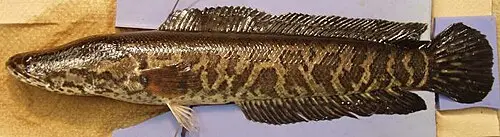
 📸 Photo
Photo: USGS · Public domain · Wikimedia Commons Source
Snakehead
Channa argus (Snakehead · カムルチー)
💡 Everyday Comparisons for Size, Mass & Speed
- 💡 FishBase notes that it is used as a food fish.
- 💡 Its maximum length of 1 m equals a 1 m ruler, and its maximum weight of 9.5 kg is slightly lighter than a 10 kg bag of rice (Comparison).
- 💡 FishBase reports that it was introduced to Japan and the United States and has had adverse ecological impacts.
Reference standards: coach bus ~12 m, mid-size car ~4.9 m, compact car ~1 t, basketball hoop 3.05 m, credit card 8.56 cm.
Site-computed relative index from recorded values; not a formal scientific metric.
📖 1. Overview
The Snakehead is an elongated freshwater fish up to 1 m long that lives in reservoirs and swamps and is also able to breathe air.
🦴 2. Anatomy & Morphology
Its body is slender, long, and cylindrical, with a lower jaw longer than the upper jaw and sharp teeth on both jaws. It has an accessory respiratory organ for breathing air.
🔍 3. Ecology & Behavior
It is an ambush hunter that hides on the bottom and waits to catch small fish and amphibians. From May to August, males and females build a floating nest of aquatic plants about 1 m in diameter at the surface, lay eggs, and guard them until they hatch.
🇰🇷 4. Connection to Korea
The National List of Species of Korea notes that it lives across almost all of Korea except the northern East Sea coast and the Hamgyeong-do region.
📚 Sources & References
- • IUCN Red List LC (2022) — https://www.iucnredlist.org/species/13151166/13151169
- • IUCN Red List category LC — latest assessment at iucnredlist.org
- • catalogueoflife.org — TM2L
- • iucnredlist.org — 13151169
- • 국가생물종목록(국립생물자원관) ktsn 120000059215 — https://species.nibr.go.kr/home/mainHome.do?cont_link=009&subMenu=009002&contCd=009002&ktsn=120000059215
- • wikidata.org — Q1156826
- • commons.wikimedia.org — File:Northern snakehead.jpg
- • fishbase.se — Channa-argus.html
- • species.nibr.go.kr — list
- • Silhouette: PhyloPic — Christopher Kenaley · CC0 1.0
Recorded dimensions are widely cited representative estimates from public literature and may vary by study or specimen.