 📸 Photo
Photo: datadan · CC BY 4.0 · Wikimedia Commons Source
Serval
Leptailurus serval (Serval · サーバル)
💡 Everyday Comparisons for Size, Mass & Speed
- 💡 Its maximum weight of 18 kg is slightly lighter than a 20 kg bag of rice (Comparison), while its average weight of 14 kg equals about 1.4 bags of 10 kg rice.
- 💡 Crossing a Serval with a domestic cat produces the Savannah cat breed, and Servals are traded as exotic pets (ADW); their pelts were also used for chiefs' mantles in some tribes.
Reference standards: coach bus ~12 m, mid-size car ~4.9 m, compact car ~1 t, basketball hoop 3.05 m, credit card 8.56 cm.
Site-computed relative index from recorded values; not a formal scientific metric.
📖 1. Overview
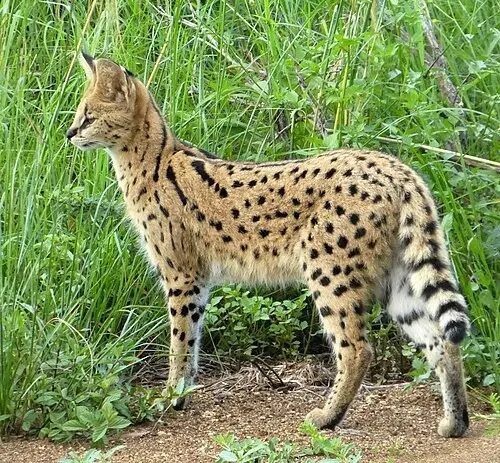
The Serval is a slender, agile wild cat living in African reed beds and grasslands. Relative to its body size, it has the longest legs and largest ears in the cat family.
🦴 2. Anatomy & Morphology
Its coat is coppery with white on the belly and parts of the face, marked with black spots and stripes whose size and placement vary by individual. Stripes running from the top of the head down the back split into four lines.
🔍 3. Ecology & Behavior
Hunting at dawn and dusk, 93.5% of its diet consists of small mammals such as rats, mice, and shrews, and 5% is birds. Its hunting success rate of 48% is high among felids, and after a gestation of 10–11 weeks females give birth to 2–3 kittens.
🇰🇷 4. Connection to Korea
No direct record connecting this species to Korea has been found.
📚 Sources & References
- • IUCN Red List LC (2019) — https://www.iucnredlist.org/species/11638/156536762
- • IUCN Red List category LC — latest assessment at iucnredlist.org
- • mammaldiversity.org — 1006005
- • iucnredlist.org — 156536762
- • wikidata.org — Q42699
- • commons.wikimedia.org — File:Leptailurus serval 61666728, crop.jpg
- • animaldiversity.org — Leptailurus serval
- • Silhouette: PhyloPic — Margot Michaud · CC0 1.0
Recorded dimensions are widely cited representative estimates from public literature and may vary by study or specimen.