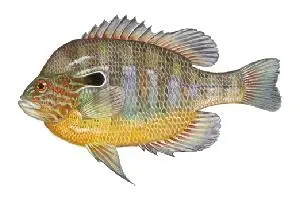
 📸 Photo
Photo: NOAA · Public domain · Wikimedia Commons Source
Bluegill
Lepomis macrochirus (Bluegill · ブルーギル)
💡 Everyday Comparisons for Size, Mass & Speed
- 💡 Its typical length of 10–15 cm is slightly longer than the long side of a credit card (8.56 cm) (Comparison).
- 💡 In the United States, it is an important game fish that tastes good and is also stocked in rivers and lakes as prey for largemouth bass (Animal Diversity Web).
- 💡 In Korea, it is an alien species found in most reservoirs and some rivers (National List of Species of Korea).
Reference standards: coach bus ~12 m, mid-size car ~4.9 m, compact car ~1 t, basketball hoop 3.05 m, credit card 8.56 cm.
Site-computed relative index from recorded values; not a formal scientific metric.
📖 1. Overview
The bluegill is a freshwater fish native to North America that was introduced into Korea and now lives in most reservoirs and some rivers. It prefers standing water with aquatic plants and dislikes flowing water.
🦴 2. Anatomy & Morphology
Its body is laterally compressed, deep, and short. There is a dark blue spot at the rear tip of the gill cover, and 8–9 brown vertical bars run along the sides of its body.
🔍 3. Ecology & Behavior
It feeds on zooplankton, aquatic insects, shrimp, small fish, and fish eggs. From April to June, the male builds a nest on gravel or sandy bottoms, attracts females to spawn, and guards the eggs until they hatch.
🇰🇷 4. Connection to Korea
According to the National List of Species of Korea, it is an introduced alien species native to the United States and is found in most reservoirs and some rivers.
📚 Sources & References
- • IUCN Red List LC (2019) — https://www.iucnredlist.org/species/61260/58309944
- • IUCN Red List category LC — latest assessment at iucnredlist.org
- • catalogueoflife.org — 3TG2J
- • iucnredlist.org — 58309944
- • 국가생물종목록(국립생물자원관) ktsn 120000058389 — https://species.nibr.go.kr/home/mainHome.do?cont_link=009&subMenu=009002&contCd=009002&ktsn=120000058389
- • wikidata.org — Q1148148
- • commons.wikimedia.org — File:Lepomis macrochirus.jpg
- • animaldiversity.org — Lepomis macrochirus
- • species.nibr.go.kr — mainHome.do
- • fishbase.se — Lepomis-macrochirus.html
- • Silhouette: PhyloPic — author not recorded · CC0 1.0
Recorded dimensions are widely cited representative estimates from public literature and may vary by study or specimen.