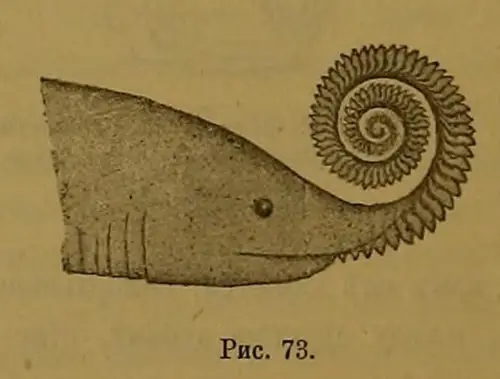
 🎨 Restoration
Restoration: Alexander Karpinsky · Public domain · Wikimedia Commons Source
Life restorations are artistic reconstructions based on fossil evidence; true coloration and soft-tissue details remain uncertain.
Helicoprion
Helicoprion bessonowi (Helicoprion · Helicoprion)
Known only from fossils. The IUCN Red List assesses only species extant since 1500 CE, so fossil taxa are not assigned a category.
💡 Everyday Comparisons for Size, Mass & Speed
- 💡 Its teeth look so much like a spiral saw blade that a Science News article was titled "Ancient fish had buzz-saw jaw" (Comparison).
- 💡 The 2013 study that first confirmed the three-dimensional jaw structure inside the fossil using hospital-style CT technology was conducted on specimens from the Idaho Museum of Natural History.
Reference standards: coach bus ~12 m, mid-size car ~4.9 m, compact car ~1 t, basketball hoop 3.05 m, credit card 8.56 cm.
📖 1. Overview
Helicoprion bessonowi (genus Helicoprion) was a cartilaginous fish that lived in Permian seas; although shark-like, it belongs to the stem lineage toward chimaeras (holocephalans). It is famous for its spirally coiled tooth fossils.
🦴 2. Anatomy & Morphology
CT imaging showed for the first time that the spiral tooth cluster (a saw-blade-like tooth whorl) filled the entire lower jaw and was supported along the midline. It had a unique system in which new teeth were continually added and retained.
🔍 3. Fossil Record & Paleoecology
Because its cartilaginous body rarely fossilized, almost all known fossils consist only of teeth. The Idaho Museum of Natural History at Idaho State University holds the world's largest public collection of its fossils.
🇰🇷 4. Connection to Korea
No direct record connecting this species to Korea has been found.
📚 Sources & References
- • Fossil taxon — the IUCN Red List assesses only species living or extinct since 1500
- • paleobiodb.org — basicTaxonInfo
- • wikidata.org — Q20718393
- • commons.wikimedia.org — File:Karpinsky 1899 Helicoprion bessonowi Fig. 73.png
- • isu.edu — idaho-state-university-researchers-solve-mysteries-of-ancien
- • pmc.ncbi.nlm.nih.gov — PMC3639784
- • science.org — scienceshot-ancient-fish-sported-circular-saw-jaw
- • Silhouette: PhyloPic — Olof Moleman · CC BY 4.0 (Congeneric silhouette — Helicoprion davisii)
Recorded dimensions are widely cited representative estimates from public literature and may vary by study or specimen.