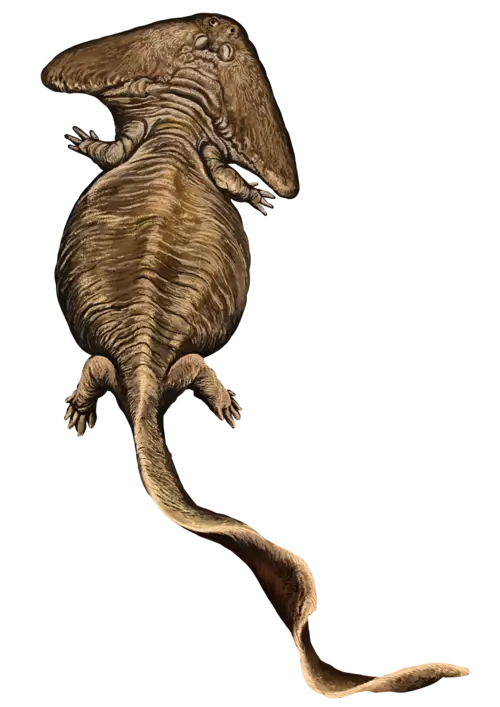
 🎨 Restoration
Restoration: DataBase Center for Life Science (DBCLS) · CC BY 4.0 · Wikimedia Commons Source
Life restorations are artistic reconstructions based on fossil evidence; true coloration and soft-tissue details remain uncertain.
Diplocaulus
Diplocaulus magnicornis (Diplocaulus · Diplocaulus)
Known only from fossils. The IUCN Red List assesses only species extant since 1500 CE, so fossil taxa are not assigned a category.
💡 Everyday Comparisons for Size, Mass & Speed
- 💡 A skull length of about 100 mm, at which it takes on its adult shape, is slightly longer than the long side of a credit card (about 86 mm) (Comparison).
- 💡 The average skull length of the youngest group, about 21 mm, is smaller than the diameter of a Korean 500-won coin (26.5 mm) (Comparison).
Reference standards: coach bus ~12 m, mid-size car ~4.9 m, compact car ~1 t, basketball hoop 3.05 m, credit card 8.56 cm.
📖 1. Overview
Diplocaulus magnicornis (genus Diplocaulus) is a nectridean (a group of amphibians) commonly found in Early Permian strata of Texas in the United States. It is characterized by laterally projecting "horns" at the back of its skull.
🦴 2. Anatomy & Morphology
As it matured, the tips of the horns at the back of the skull grew rapidly sideways. The adult shape was established when the midline skull length reached about 100 mm, while the youngest group averaged about 21 mm.
🔍 3. Fossil Record & Paleoecology
The most common species in the Arroyo Formation of Texas, it lived mainly in ponds, whereas another species (D. brevirostris) lived in streams. Growth did not proceed uniformly but took place in two stages divided into a juvenile phase and a subsequent phase.
🇰🇷 4. Connection to Korea
No direct record connecting this species to Korea has been found.
📚 Sources & References
- • Fossil taxon — the IUCN Red List assesses only species living or extinct since 1500
- • paleobiodb.org — basicTaxonInfo
- • wikidata.org — Q124482033
- • commons.wikimedia.org — File:202012 Diplocaulus.png
- • archive.org — faunaofuppervale1014olso bw.pdf
- • bioone.org — 0272-4634(2001)021[0803:ASAOAG]2.0.CO;2.full
- • Silhouette: PhyloPic — Gareth Monger · CC BY 3.0 (Congeneric silhouette — Diplocaulus)
Recorded dimensions are widely cited representative estimates from public literature and may vary by study or specimen.