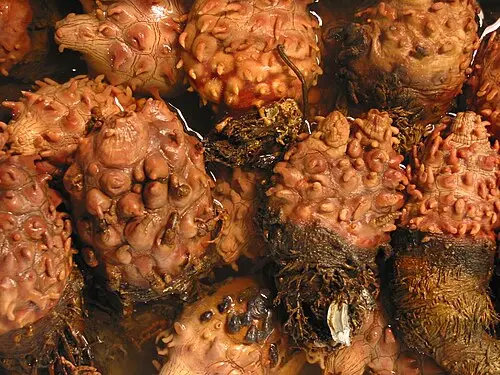
 📸 Photo
Photo: bifyu · CC BY-SA 2.0 · Wikimedia Commons Source
Sea pineapple
Halocynthia roretzi (Sea pineapple · マボヤ)
Not Evaluated (NE) on the IUCN Red List yet.
💡 Everyday Comparisons for Size, Mass & Speed
- 💡 It is a seafood eaten in Korea, Japan, and China, and its distinctive flavor comes from a compound called cynthiol (Encyclopedia of Korean Culture).
- 💡 Fisheries outlook reports projecting reduced supply in 2025–2026 due to mass die-offs at sea squirt farms in Gyeongnam and Gyeongbuk from high water temperatures in summer 2024 connect directly with the news (Encyclopedia of Korean Culture).
- 💡 Its maximum size of 12 cm in photographs is slightly shorter than a ballpoint pen (about 14 cm).
Reference standards: coach bus ~12 m, mid-size car ~4.9 m, compact car ~1 t, basketball hoop 3.05 m, credit card 8.56 cm.
📖 1. Overview
The sea pineapple is a chordate that lives attached to sea rocks or seashells, nicknamed 'sea pineapple' because of its bumpy shape.
🦴 2. Anatomy & Morphology
Its attached body is oval, and its tough outer tunic made of cellulose has many thick projections. It attaches to rocks with root-like projections at the rear and has an incurrent siphon and excurrent siphon at the front.
🔍 3. Ecology & Behavior
It draws in seawater through its incurrent siphon and filters plankton and organic matter with its branchial sac. It is hermaphroditic, and the notochord present in the tadpole-like larva disappears once it settles as an adult.
🇰🇷 4. Connection to Korea
Its official name in the National List of Species of Korea is 'Ureongswengi'; it is widely farmed along the coasts of Gyeongsangnam-do, Gyeongsangbuk-do, and Gangwon-do and shipped mainly from February to June. It dies off at high water temperatures above 25°C, causing heavy losses at farms in Gyeongnam and Gyeongbuk in summer 2024.
📚 Sources & References
- • IUCN Red List: not evaluated (NE) — cross-checked with the Wikidata conservation-status entry
- • marinespecies.org — aphia.php
- • 국가생물종목록(국립생물자원관) ktsn 120000051045 — https://species.nibr.go.kr/home/mainHome.do?cont_link=009&subMenu=009002&contCd=009002&ktsn=120000051045
- • wikidata.org — Q671668
- • commons.wikimedia.org — File:Halocynthia roretzi-Sea pineapples at Tsukiji Market-01
- • sc.niigata-u.ac.jp — maboya.html
- • encykorea.aks.ac.kr — E0018112
- • Silhouette: PhyloPic — author not recorded · CC0 1.0 (Congeneric silhouette — Halocynthia papillosa)
Recorded dimensions are widely cited representative estimates from public literature and may vary by study or specimen.