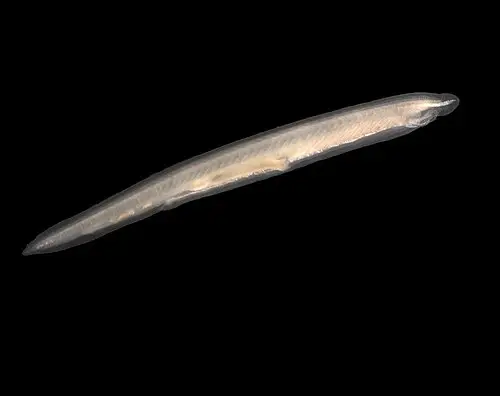
 📸 Photo
Photo: Hans Hillewaert · CC BY-SA 4.0 · Wikimedia Commons Source
European lancelet
Branchiostoma lanceolatum (European lancelet · European lancelet)
Not Evaluated (NE) on the IUCN Red List yet.
💡 Everyday Comparisons for Size, Mass & Speed
- 💡 Its recorded depth of 7–9 m is shallower than the height of a 3-story building (about 10 m) (Comparison).
- 💡 It is a sand-loving animal widely distributed along the North Sea coastal zone off Belgium (SeaLifeBase).
Reference standards: coach bus ~12 m, mid-size car ~4.9 m, compact car ~1 t, basketball hoop 3.05 m, credit card 8.56 cm.
📖 1. Overview
The European lancelet is a small chordate that lives buried in coarse sediment in shallow waters of the northeastern Atlantic, Mediterranean, and western Indian Ocean.
🦴 2. Anatomy & Morphology
It has extensive fin-like structures along its body that allow it to swim short distances. Fine tentacles surrounding the mouth help gather food.
🔍 3. Ecology & Behavior
Buried in coarse sediment with less than 10% mud content, it non-selectively filter-feeds on detritus, phytoplankton, and copepods in the water. Sexes are separate, and eggs develop into planktonic larvae before settling as benthic adults.
🇰🇷 4. Connection to Korea
No direct record connecting this species to Korea has been found.
📚 Sources & References
- • IUCN Red List: not evaluated (NE) — cross-checked with the Wikidata conservation-status entry
- • marinespecies.org — aphia.php
- • wikidata.org — Q2267046
- • commons.wikimedia.org — File:Branchiostoma lanceolatum.jpg
- • sealifebase.se — Branchiostoma-lanceolatum.html
- • Silhouette: PhyloPic — Yan Wong from illustration by Jules Richard (1907) · CC0 1.0
Recorded dimensions are widely cited representative estimates from public literature and may vary by study or specimen.