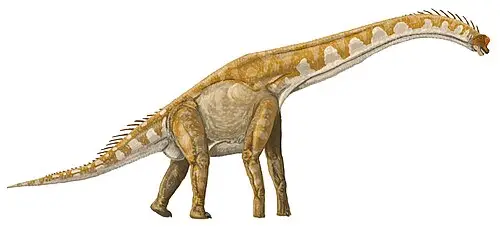
 🎨 Restoration
Restoration: Dmitry Bogdanov · Public domain · Wikimedia Commons Source
Life restorations are artistic reconstructions based on fossil evidence; true coloration and soft-tissue details remain uncertain.
Giraffatitan
Giraffatitan brancai (Giraffatitan · Giraffatitan)
Known only from fossils. The IUCN Red List assesses only species extant since 1500 CE, so fossil taxa are not assigned a category.
💡 Everyday Comparisons for Size, Mass & Speed
- 💡 An estimated body length of 23 m is more than the length of one and a half London double-decker buses (about 14 m each) (Comparison).
- 💡 A skeleton of this species stands at the Museum für Naturkunde in Berlin, Germany, and is listed in Guinness World Records as the "largest mounted dinosaur skeleton in the world."
Reference standards: coach bus ~12 m, mid-size car ~4.9 m, compact car ~1 t, basketball hoop 3.05 m, credit card 8.56 cm.
📖 1. Overview
Giraffatitan brancai (genus Giraffatitan) was a herbivorous sauropod that lived in what is now Tanzania about 154–142 million years ago, and its name means "giraffe titan."
🦴 2. Anatomy & Morphology
It is a sauropod, and some scholars consider it a separate genus from Brachiosaurus.
🔍 3. Fossil Record & Paleoecology
Because bones from multiple individuals have been found, its body structure is relatively well understood. The skeleton displayed at the Museum für Naturkunde in Berlin holds the Guinness World Record for the largest mounted dinosaur skeleton.
🇰🇷 4. Connection to Korea
No direct record connecting this species to Korea has been found.
📚 Sources & References
- • Fossil taxon — the IUCN Red List assesses only species living or extinct since 1500
- • paleobiodb.org — basicTaxonInfo
- • wikidata.org — Q124481950
- • commons.wikimedia.org — File:Giraffatitan DB.jpg
- • nhm.ac.uk — giraffatitan.html
- • museumfuernaturkunde.berlin — the-world-of-dinosaurs
- • nhm.ac.uk — how-big-was-diplodocus-carnegii.html
- • Silhouette: PhyloPic — Amy Beauvois · CC0 1.0
Recorded dimensions are widely cited representative estimates from public literature and may vary by study or specimen.