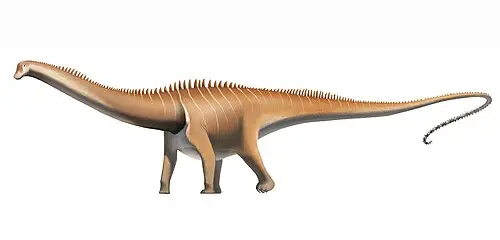
 🎨 Restoration
Restoration: Fred Wierum · CC BY-SA 4.0 · Wikimedia Commons Source
Life restorations are artistic reconstructions based on fossil evidence; true coloration and soft-tissue details remain uncertain.
Diplodocus
Diplodocus carnegii (Diplodocus · Diplodocus)
Known only from fossils. The IUCN Red List assesses only species extant since 1500 CE, so fossil taxa are not assigned a category.
💡 Everyday Comparisons for Size, Mass & Speed
- 💡 An estimated body length of 26 m is close to the length of two London double-decker buses (about 14 m each) placed end to end (Comparison).
- 💡 "Dippy" at the Natural History Museum in London is a replica skeleton of Diplodocus carnegii gifted to the museum by Andrew Carnegie in 1905.
Reference standards: coach bus ~12 m, mid-size car ~4.9 m, compact car ~1 t, basketball hoop 3.05 m, credit card 8.56 cm.
Site-computed relative index from recorded values; not a formal scientific metric.
📖 1. Overview
Diplodocus carnegii (genus Diplodocus) was a four-legged herbivorous sauropod that lived in North America during the Late Jurassic (about 152–145 million years ago), with a very long neck and a whip-like tail.
🦴 2. Anatomy & Morphology
Because the bones on the underside of its tail vertebrae had an inverted V-shape, it was named "double beam," and it may have had narrow, pointed bony spines along its back.
🔍 3. Fossil Record & Paleoecology
With its long neck, it fed on soft foliage both high and low. All known fossils came from the Morrison Formation across several U.S. states, where tree ferns and cycads grew at the time.
🇰🇷 4. Connection to Korea
No direct record connecting this species to Korea has been found.
📚 Sources & References
- • Fossil taxon — the IUCN Red List assesses only species living or extinct since 1500
- • paleobiodb.org — basicTaxonInfo
- • wikidata.org — Q3708878
- • commons.wikimedia.org — File:Diplodocus carnegii.jpg
- • nhm.ac.uk — diplodocus.html
- • nhm.ac.uk — how-big-was-diplodocus-carnegii.html
- • nhm.ac.uk — dippy-returns-to-the-natural-history-museum.html
- • Silhouette: PhyloPic — Scott Hartman · CC BY 3.0
Recorded dimensions are widely cited representative estimates from public literature and may vary by study or specimen.