 📸 Photo
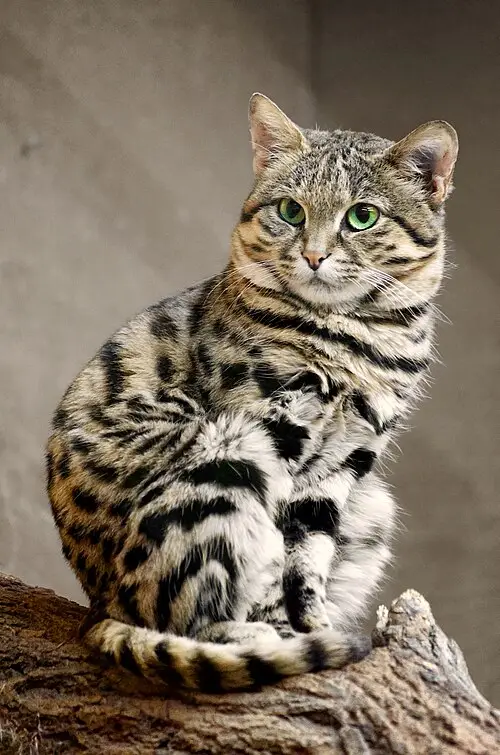
Photo: Patrick Ch. Apfeld , derivative editing by Poke2001 · CC BY 3.0 · Wikimedia Commons Source
Black-footed Cat
Felis nigripes (Black-footed Cat · クロアシネコ)
💡 Everyday Comparisons for Size, Mass & Speed
- 💡 Its maximum body length of 50 cm is about 1.7 times the long side of A4 paper, and its maximum weight of 2.75 kg is just under two 1.5 L bottles of water (Comparison).
- 💡 By preying on small rodents, it helps reduce crop pests and disease-carrying mice (ADW).
Reference standards: coach bus ~12 m, mid-size car ~4.9 m, compact car ~1 t, basketball hoop 3.05 m, credit card 8.56 cm.
Site-computed relative index from recorded values; not a formal scientific metric.
📖 1. Overview
The Black-footed Cat is a small cat living in dry grasslands and deserts of southern Africa and is the smallest African species of the genus Felis. It uses rodent burrows or abandoned termite mounds as dens.
🦴 2. Anatomy & Morphology
Its light brown coat is covered with black to dark brown spots and stripes, and the tip of its tail is black. It gets its name from its black paw pads, which are visible as it walks, and its tail is about half its body length.
🔍 3. Ecology & Behavior
Solitary and nocturnal, 98% of its diet consists of mammals (72%) and birds (26%), and more than half of its prey weighs less than 40 g. Males use home ranges of 13–20 km² and females 10–12 km².
🇰🇷 4. Connection to Korea
No direct record connecting this species to Korea has been found.
📚 Sources & References
- • IUCN Red List VU (2026) — https://www.iucnredlist.org/species/8542/288685609
- • IUCN Red List category VU — latest assessment at iucnredlist.org
- • mammaldiversity.org — 1005989
- • iucnredlist.org — 288685609
- • wikidata.org — Q204814
- • commons.wikimedia.org — File:Zoo Wuppertal Schwarzfusskatze.jpg
- • animaldiversity.org — Felis nigripes
- • Silhouette: PhyloPic — Margot Michaud · CC0 1.0
Recorded dimensions are widely cited representative estimates from public literature and may vary by study or specimen.