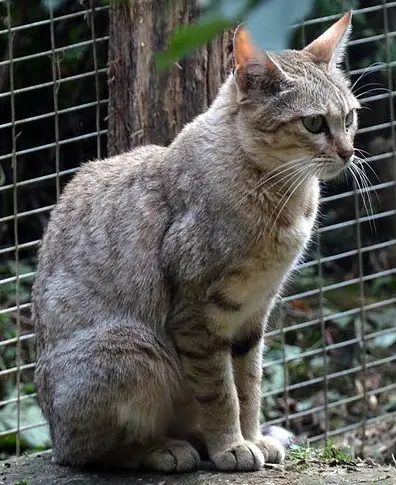
 📸 Photo
Photo: Vassil · CC BY-SA 4.0 · Wikimedia Commons Source
African Wildcat
Felis lybica (African Wildcat · リビアヤマネコ)
💡 Everyday Comparisons for Size, Mass & Speed
- 💡 A male's average weight of 5 kg is similar to that of a domestic cat, and its length of 0.75 m is about the length of a long umbrella (Comparison).
- 💡 Domestic cats appear to have originated from the African Wildcat and Asian desert cats (ADW).
Reference standards: coach bus ~12 m, mid-size car ~4.9 m, compact car ~1 t, basketball hoop 3.05 m, credit card 8.56 cm.
Site-computed relative index from recorded values; not a formal scientific metric.
📖 1. Overview
The African Wildcat is a wild cat widely distributed across Africa and the Arabian Peninsula and is the lineage from which the domestic cat descended. It lives in habitats ranging from forests to arid regions, though in deserts it stays near mountains and waterways.
🦴 2. Anatomy & Morphology
Its coat is paler and less dense than that of the European wildcat, and its tail is thin with a tapering tip. Coat color varies with latitude from sandy yellow to gray or brown, with a reddish tint behind the ears.
🔍 3. Ecology & Behavior
Mostly solitary, it is active at night and around dawn and dusk. It feeds mainly on small rodents such as mice and can also take prey as large as itself. Gestation in wildcats lasts 56–68 days, with litters of 1–8 kittens (average 3.4).
🇰🇷 4. Connection to Korea
No direct record connecting this species to Korea has been found.
📚 Sources & References
- • IUCN Red List LC (2022) — https://www.iucnredlist.org/species/131299383/154907281
- • IUCN Red List category LC — latest assessment at iucnredlist.org
- • mammaldiversity.org — 1005987
- • iucnredlist.org — 154907281
- • wikidata.org — Q47482585
- • commons.wikimedia.org — File:Felis silvestris lybica 1.jpg
- • animaldiversity.org — Felis silvestris
- • animaldiversity.org — Felis catus
- • Silhouette: PhyloPic — David Orr · Public Domain Mark 1.0
Recorded dimensions are widely cited representative estimates from public literature and may vary by study or specimen.