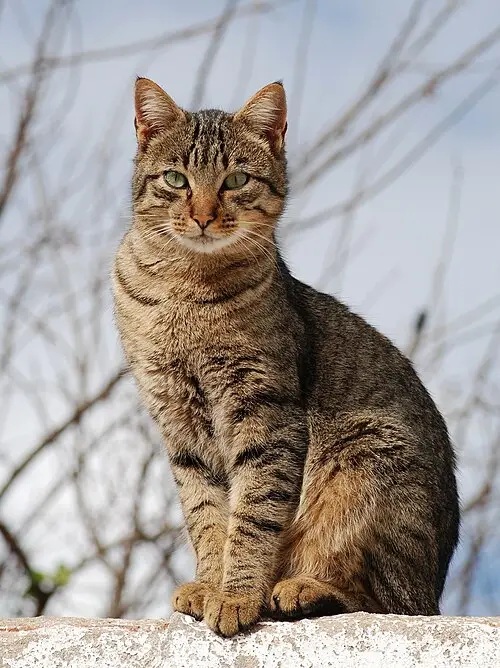
 📸 Photo
Photo: Alvesgaspar · CC BY-SA 3.0 · Wikimedia Commons Source
Domestic Cat
Felis catus (Domestic Cat · ヨーロッパヤマネコ)
Not Evaluated (NE) on the IUCN Red List yet.
💡 Everyday Comparisons for Size, Mass & Speed
- 💡 Its weight of 4.1–5.4 kg is similar to 3–4 bottles of 1.5 L water (Comparison), and its average length of 76 cm is about the length of a long umbrella.
- 💡 Besides being a pet and a model organism in medical research, the Domestic Cat has been used for thousands of years to control rodents (ADW), which is likely why it was first domesticated.
Reference standards: coach bus ~12 m, mid-size car ~4.9 m, compact car ~1 t, basketball hoop 3.05 m, credit card 8.56 cm.
Site-computed relative index from recorded values; not a formal scientific metric.
📖 1. Overview
The Domestic Cat is a companion animal living alongside humans. Thought to have descended from wildcats of Africa and Asia, it has over 100 breeds.
🦴 2. Anatomy & Morphology
Even across different breeds, body shape and size are similar, with about 244 bones including about 30 vertebrae. Scent glands near the ears, neck, and back of the head release odor when rubbed against objects to mark territory.
🔍 3. Ecology & Behavior
A carnivore, it hunts rodents such as mice and birds, or relies on food provided by humans, needing 200–300 kcal per day for females and 250–300 kcal for males. During the breeding season, females come into estrus about every 21 days.
🇰🇷 4. Connection to Korea
No direct record connecting this species to Korea has been found.
📚 Sources & References
- • IUCN Red List: not evaluated (NE) — cross-checked with the Wikidata conservation-status entry
- • mammaldiversity.org — 1005985
- • wikidata.org — Q20980826
- • commons.wikimedia.org — File:Cat November 2010-1a.jpg
- • animaldiversity.org — Felis catus
- • Silhouette: PhyloPic — David Orr · Public Domain Mark 1.0
Recorded dimensions are widely cited representative estimates from public literature and may vary by study or specimen.