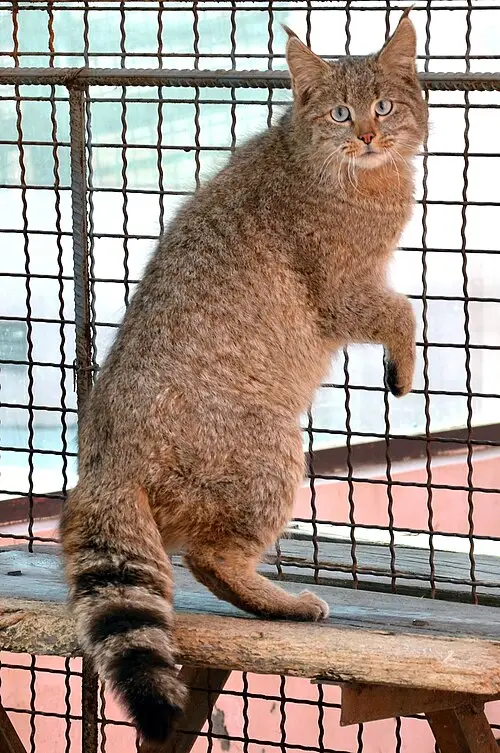
 📸 Photo
Photo: 西宁野生动物园 · CC BY-SA 3.0 · Wikimedia Commons Source
Chinese Mountain Cat
Felis bieti (Chinese Mountain Cat · ハイイロネコ)
💡 Everyday Comparisons for Size, Mass & Speed
- 💡 Its maximum weight of 9 kg is slightly lighter than a 10 kg bag of rice, and its body length of about 85 cm is around the length of a long umbrella (Comparison).
- 💡 Because pikas eat grass that livestock could graze, some Chinese farmers view them as pests, and this cat helps keep their numbers down (ADW). Although hunting is illegal, its pelts are still found in Chinese markets.
Reference standards: coach bus ~12 m, mid-size car ~4.9 m, compact car ~1 t, basketball hoop 3.05 m, credit card 8.56 cm.
Site-computed relative index from recorded values; not a formal scientific metric.
📖 1. Overview
The Chinese Mountain Cat is a wild cat living in alpine meadows and forest edges of China at 2,500–5,000 m in elevation. Although also called the 'Chinese desert cat,' it does not live in deserts.
🦴 2. Anatomy & Morphology
It has a broad, sturdy build with relatively short legs and tail. Its coat is pale gray in winter and brown in summer, with dark gray stripes on the body, legs, and tail and a black tail tip. Its bony auditory bullae make up 25% of the skull length.
🔍 3. Ecology & Behavior
It preys mainly on pikas, zokors, and other rodents, listening for them in their burrows and digging them out. Solitary, it rests in rock-crevice burrows by day, mates from January to March, and gives birth to 2–4 kittens around May.
🇰🇷 4. Connection to Korea
No direct record connecting this species to Korea has been found.
📚 Sources & References
- • IUCN Red List VU (2022) — https://www.iucnredlist.org/species/8539/213200674
- • IUCN Red List category VU — latest assessment at iucnredlist.org
- • mammaldiversity.org — 1005984
- • iucnredlist.org — 213200674
- • wikidata.org — Q204322
- • commons.wikimedia.org — File:Chinese Mountain Cat (Felis Bieti) in XiNing Wild Zoo 2
- • animaldiversity.org — Felis bieti
- • Silhouette: PhyloPic — Margot Michaud · CC0 1.0
Recorded dimensions are widely cited representative estimates from public literature and may vary by study or specimen.