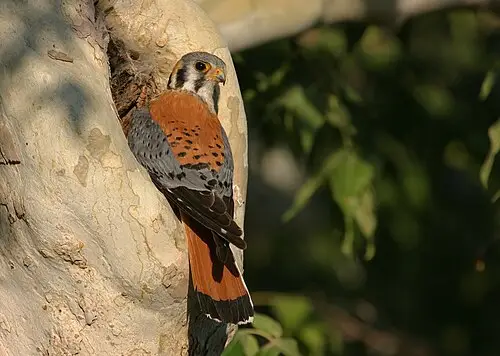
 📸 Photo
Photo: Gregory "Slobirdr" Smith · CC BY-SA 2.0 · Wikimedia Commons Source
American Kestrel
Falco sparverius (American Kestrel · アメリカチョウゲンボウ)
💡 Everyday Comparisons for Size, Mass & Speed
- 💡 Its maximum weight of 165 g is about the weight of three chicken eggs, and its wingspan of 61 cm is roughly the length of an adult's arm (Comparison).
- 💡 In the United States, it is one of the birds permitted for beginner falconers, and it helps farmers by catching rodents and insects (ADW "Economic Importance for Humans: Positive").
- 💡 Sick or dead individuals serve as an early warning signal for West Nile virus outbreaks, so public health authorities use them for monitoring (ADW).
Reference standards: coach bus ~12 m, mid-size car ~4.9 m, compact car ~1 t, basketball hoop 3.05 m, credit card 8.56 cm.
Site-computed relative index from recorded values; not a formal scientific metric.
📖 1. Overview
The American Kestrel is a small falcon adapted to almost every habitat, from fields and cities to deserts, mountains, and tropical lowlands. It can live wherever there are cavities for nesting, open ground for hunting, and tall perches.
🦴 2. Anatomy & Morphology
Males have blue-gray wings and crowns while females are reddish-brown, and juveniles resemble females. Both sexes have two bold black vertical slashes on the face and a sharp, pointed beak.
🔍 3. Ecology & Behavior
In summer it catches insects such as grasshoppers, crickets, butterflies, and beetles, and in winter it hunts mice, voles, snakes, frogs, and small birds. It hunts by hovering in place, waiting on high perches, or catching insects in flight.
🇰🇷 4. Connection to Korea
No direct record connecting this species to Korea has been found.
📚 Sources & References
- • IUCN Red List LC (2025) — https://www.iucnredlist.org/species/22696395/140950605
- • IUCN Red List category LC — latest assessment at iucnredlist.org
- • doi.org — avilist.v2026
- • iucnredlist.org — 140950605
- • wikidata.org — Q651545
- • commons.wikimedia.org — File:American Kestrel (Falco sparverius) (14547482002).jpg
- • animaldiversity.org — Falco sparverius
- • Silhouette: PhyloPic — Andy Wilson · CC0 1.0
Recorded dimensions are widely cited representative estimates from public literature and may vary by study or specimen.