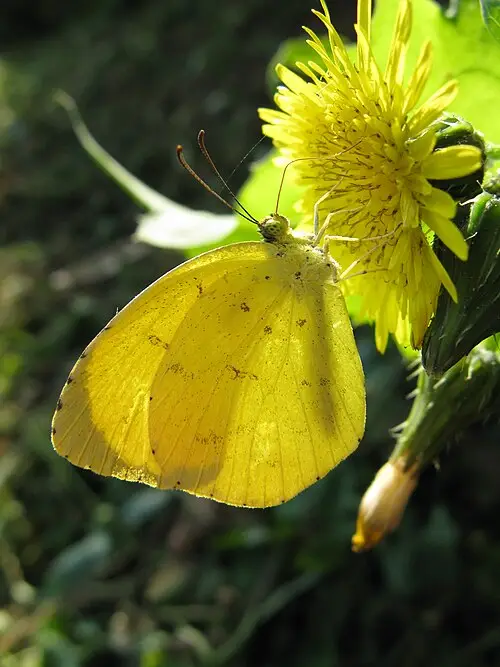
 📸 Photo
Photo: KENPEI · CC BY-SA 3.0 · Wikimedia Commons Source
Japanese common grass yellow
Eurema mandarina (Japanese common grass yellow · キタキチョウ)
Not Evaluated (NE) on the IUCN Red List yet.
💡 Everyday Comparisons for Size, Mass & Speed
- 💡 Along grassy edges or weedy patches around forests, it can be seen flying low to visit daisy fleabane and self-heal flowers (National List of Species of Korea).
- 💡 Because adults emerge in May and remain visible until late autumn, you can encounter them from spring walks to late-autumn country paths (National List of Species of Korea: emerging in May to late autumn).
Reference standards: coach bus ~12 m, mid-size car ~4.9 m, compact car ~1 t, basketball hoop 3.05 m, credit card 8.56 cm.
📖 1. Overview
The Japanese common grass yellow is a yellow butterfly in the family Pieridae that is abundant among weeds and around forests, flying low to the ground. Adults appear in May and can be seen until late autumn.
🦴 2. Anatomy & Morphology
Its wing background is yellow with jagged black markings along the forewing margin and black markings along the hindwing margin as well. Dark brown markings are scattered across the underside of the wings with individual variation, and males are a deeper yellow than females.
🔍 3. Ecology & Behavior
It flies low while sipping nectar from flowers such as daisy fleabane and self-heal. The host plant eaten by the caterpillars is Chinese bushclover (Lespedeza cuneata).
🇰🇷 4. Connection to Korea
No direct record connecting this species to Korea has been found.
📚 Sources & References
- • IUCN Red List: not evaluated (NE) — cross-checked with the Wikidata conservation-status entry
- • checklistbank.org — P2JQT
- • 국가생물종목록(국립생물자원관) ktsn 120000035948 — https://species.nibr.go.kr/home/mainHome.do?cont_link=009&subMenu=009002&contCd=009002&ktsn=120000035948
- • wikidata.org — Q15271278
- • commons.wikimedia.org — File:Eurema mandarina1.jpg
- • species.nibr.go.kr — mainHome.do
- • Silhouette: PhyloPic — Andy Wilson · CC0 1.0 (Related taxon silhouette — Pieris rapae)
Recorded dimensions are widely cited representative estimates from public literature and may vary by study or specimen.