 📸 Photo
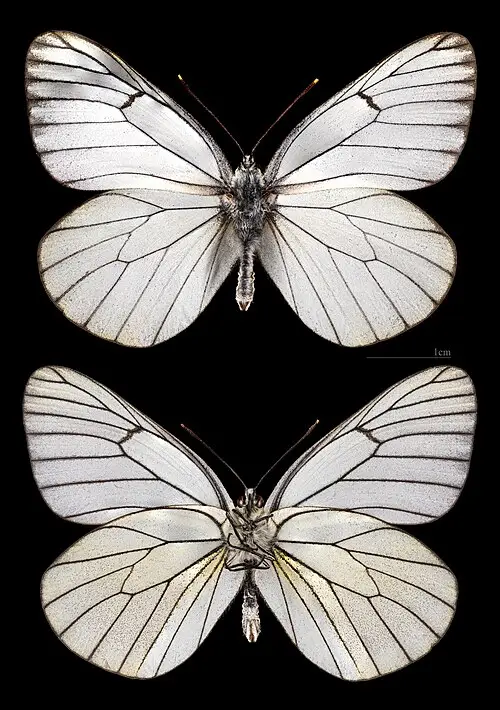
Photo: Didier Descouens · CC BY-SA 4.0 · Wikimedia Commons Source
Black-veined white
Aporia crataegi (Black-veined white · Black-veined white)
Not Evaluated (NE) on the IUCN Red List yet.
🇰🇷 Class I endangered wildlife (Korea)
💡 Everyday Comparisons for Size, Mass & Speed
- 💡 Its spread wings recall traditional white Korean attire, and its Korean name was given by likening it to a chief mourner (sangje) dressed in white mourning clothes.
- 💡 Its caterpillars eat leaves of fruit trees such as apple and apricot. Its maximum wingspan of 59 mm is about 2.2 times the diameter of a Korean 500-won coin (26.5 mm) (Comparison).
Reference standards: coach bus ~12 m, mid-size car ~4.9 m, compact car ~1 t, basketball hoop 3.05 m, credit card 8.56 cm.
📖 1. Overview
The black-veined white is a white-winged butterfly for which Korea marks the southern limit of its range; it has had no sighting records in South Korea since 1997 and is a Class I endangered wildlife (Korea) species.
🦴 2. Anatomy & Morphology
Its wingspan is 52–59 mm, with a black body and white wings covered in pale gray hairs on both the upper and lower surfaces. Males have yellow-tipped antennae and abundant white scales on their wings.
🔍 3. Ecology & Behavior
It has 1 generation per year, with adults appearing from late May to June and larvae overwintering. Females lay clusters of 50–60 eggs on host plants, and the caterpillars eat leaves of rose-family plants such as apple and apricot trees.
🇰🇷 4. Connection to Korea
It is a Class I endangered wildlife (Korea) species. Although formerly confirmed in Samcheok and Yeongwol in Gangwon-do, there have been no sighting records in South Korea since 1997, and global warming is presumed to have shifted its southern range limit northward.
📚 Sources & References
- • 멸종위기 야생생물 Ⅰ급 — 국가생물종목록(국립생물자원관) ktsn 120000035935 — https://species.nibr.go.kr/home/mainHome.do?cont_link=009&subMenu=009002&contCd=009002&ktsn=120000035935
- • IUCN Red List: not evaluated (NE) — cross-checked with the Wikidata conservation-status entry
- • Korean protection status: Class I endangered wildlife (Korea)
- • catalogueoflife.org — 5VQKD
- • 국가생물종목록(국립생물자원관) ktsn 120000035935 — https://species.nibr.go.kr/home/mainHome.do?cont_link=009&subMenu=009002&contCd=009002&ktsn=120000035935
- • wikidata.org — Q811483
- • commons.wikimedia.org — File:(MHNT) Aporia crataegi- Foret de Soreze Tarn France - m
- • nie.re.kr — view.do
- • bok.or.kr — contents.do
- • Silhouette: PhyloPic — Andy Wilson · CC0 1.0 (Related taxon silhouette — Pieris rapae)
Recorded dimensions are widely cited representative estimates from public literature and may vary by study or specimen.