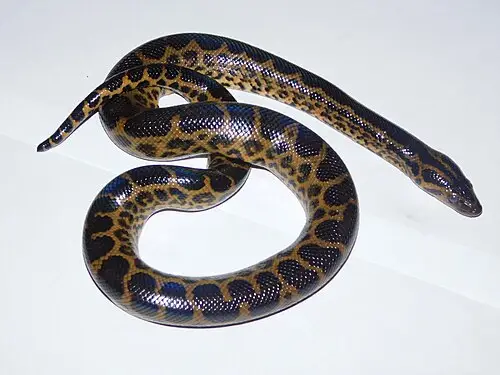
 📸 Photo
Photo: Sebastián Gómez Barboza Silveira · CC0 · Wikimedia Commons Source
Yellow Anaconda
Eunectes notaeus (Yellow Anaconda · キイロアナコンダ)
💡 Everyday Comparisons for Size, Mass & Speed
- 💡 Its maximum length of 4.6 m is similar to the length of a passenger car (about 4.5 m) (Comparison).
- 💡 Animal Diversity Web notes that Yellow Anaconda skin is sold for items such as wallets, shoes, and belts, and that the species is traded as a pet and displayed as a popular zoo attraction.
Reference standards: coach bus ~12 m, mid-size car ~4.9 m, compact car ~1 t, basketball hoop 3.05 m, credit card 8.56 cm.
Site-computed relative index from recorded values; not a formal scientific metric.
📖 1. Overview
The Yellow Anaconda is an anaconda living in swamps and marshes; though much smaller than the Green Anaconda, it reaches up to 4.6 m in length.
🦴 2. Anatomy & Morphology
Yellowish-green scales patterned with brown or black bands and overlapping spots wrap around its body, camouflaging it in murky water or forest vegetation. Females are longer and heavier than males.
🔍 3. Ecology & Behavior
It eats birds, bird eggs, small mammals, turtles, lizards, and caimans, taking wading birds most frequently in some areas while large individuals also catch deer or capybaras. Waiting hidden in water or vegetation, it strikes and constricts its prey.
🇰🇷 4. Connection to Korea
No direct record connecting this species to Korea has been found.
📚 Sources & References
- • IUCN Red List LC (2021) — https://www.iucnredlist.org/species/44580058/44580062
- • IUCN Red List category LC — latest assessment at iucnredlist.org
- • catalogueoflife.org — 6GYDP
- • iucnredlist.org — 44580062
- • wikidata.org — Q756281
- • commons.wikimedia.org — File:Eunectes notaeus 365741965.jpg
- • animaldiversity.org — Eunectes notaeus
- • Silhouette: PhyloPic — author not recorded · CC0 1.0 (Congeneric silhouette — Eunectes murinus)
Recorded dimensions are widely cited representative estimates from public literature and may vary by study or specimen.