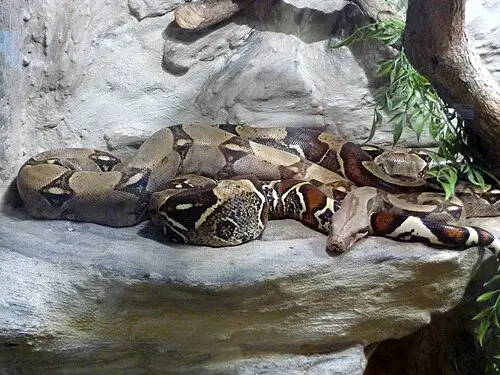
 📸 Photo
Photo: I would appreciate being notified if you use my work outside Wikimedia. Do not copy this image illegally by ignoring the terms of the license below, as it is no · CC BY-SA 4.0 · Wikimedia Commons Source
Boa Constrictor
Boa constrictor (Boa Constrictor · ボアコンストリクター)
💡 Everyday Comparisons for Size, Mass & Speed
- 💡 Its maximum length of 3.9 m is slightly shorter than a passenger car (about 4.5–5 m) (Comparison).
- 💡 At the Smithsonian National Zoo, it is fed mice, rats, and chicks.
Reference standards: coach bus ~12 m, mid-size car ~4.9 m, compact car ~1 t, basketball hoop 3.05 m, credit card 8.56 cm.
Site-computed relative index from recorded values; not a formal scientific metric.
📖 1. Overview
The Boa Constrictor is a large snake living in diverse habitats across Central and South America from northern Mexico to Argentina, catching prey by constriction.
🦴 2. Anatomy & Morphology
It usually grows to 2–3 m and up to about 3.9 m, with adults sometimes exceeding 45 kg. Newborn young are about 50 cm long, and females are larger than males.
🔍 3. Ecology & Behavior
It ambushes prey, bites and coils around it to constrict it, and swallows large lizards, birds, opossums, bats, and rodents whole. It gives birth to live young in litters of 10–64 (averaging about 25), and takes 4–6 days to digest a meal.
🇰🇷 4. Connection to Korea
No direct record connecting this species to Korea has been found.
📚 Sources & References
- • IUCN Red List LC (2021) — https://www.iucnredlist.org/species/197462/2486405
- • IUCN Red List category LC — latest assessment at iucnredlist.org
- • catalogueoflife.org — M7TX
- • iucnredlist.org — 2486405
- • wikidata.org — Q215388
- • commons.wikimedia.org — File:Boa constrictor, Vaňkovka, Brno (2).jpg
- • nationalzoo.si.edu — boa-constrictor
- • animaldiversity.org — Boa constrictor
- • Silhouette: PhyloPic — Becky Barnes · CC0 1.0
Recorded dimensions are widely cited representative estimates from public literature and may vary by study or specimen.