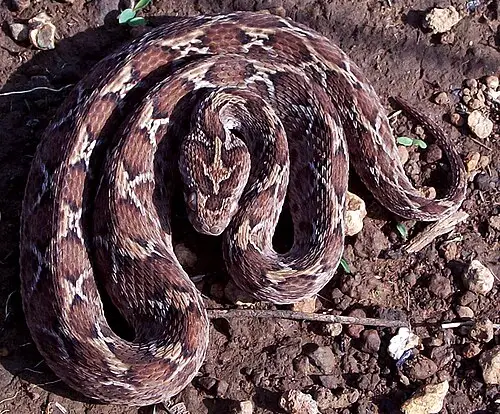
 📸 Photo
Photo: Shantanu Kuveskar · CC BY-SA 3.0 · Wikimedia Commons Source
Saw-scaled Viper
Echis carinatus (Saw-scaled Viper · ノコギリヘビ)
💡 Everyday Comparisons for Size, Mass & Speed
- 💡 The Reptile Database lists this snake along with the Spectacled Cobra, Indohwansa (a Korean animal name), and Russell's Viper as the four common venomous snakes of major medical importance to humans in India.
- 💡 Because it also inhabits the United Arab Emirates, the first observation of this snake preying on another snake was recorded there in 2025 and published in the journal Taprobanica.
Reference standards: coach bus ~12 m, mid-size car ~4.9 m, compact car ~1 t, basketball hoop 3.05 m, credit card 8.56 cm.
📖 1. Overview
The Saw-scaled Viper is a venomous snake widely distributed across arid and semi-arid regions of the Middle East and South Asia, and is one of the four common medically important venomous snakes in India.
🦴 2. Anatomy & Morphology
The genus name Echis is Greek for "viper," and the species name carinatus is Latin for "keeled like a ship's hull" (etymology of the name).
🔍 3. Ecology & Behavior
A broad-diet hunter, it eats arthropods such as scorpions and centipedes most frequently, while also preying on small lizards, rodents, and occasionally amphibians. In 2025, the first record of this snake eating another snake was reported from the United Arab Emirates.
🇰🇷 4. Connection to Korea
No direct record connecting this species to Korea has been found.
📚 Sources & References
- • IUCN Red List LC (2021) — https://www.iucnredlist.org/species/164694/1068235
- • IUCN Red List category LC — latest assessment at iucnredlist.org
- • catalogueoflife.org — 38LQF
- • iucnredlist.org — 1068235
- • wikidata.org — Q818485
- • commons.wikimedia.org — File:Saw Scaled Viper Echis carinatus.jpg
- • reptile-database.reptarium.cz — species
- • taprobanica.org — v14i2-382.html
- • Silhouette: PhyloPic — Beth Reinke · CC0 1.0 (Related taxon silhouette — Vipera berus)
Recorded dimensions are widely cited representative estimates from public literature and may vary by study or specimen.