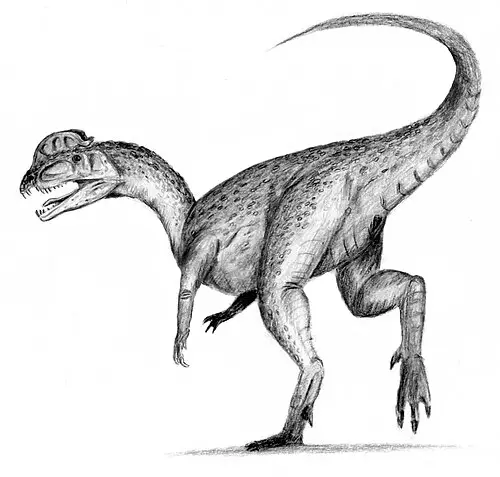
 🎨 Restoration
Restoration: No machine-readable author provided. ArthurWeasley~commonswiki assumed (based on copyright claims). · CC BY 2.5 · Wikimedia Commons Source
Life restorations are artistic reconstructions based on fossil evidence; true coloration and soft-tissue details remain uncertain.
Dilophosaurus
Dilophosaurus wetherilli (Dilophosaurus · Dilophosaurus)
Known only from fossils. The IUCN Red List assesses only species extant since 1500 CE, so fossil taxa are not assigned a category.
💡 Everyday Comparisons for Size, Mass & Speed
- 💡 An estimated body length of about 7 m (representative value for the genus) is about 1.5 times the length of a passenger car (about 4.5 m), and a weight of about 400 kg is about six adult men (about 70 kg each) (Comparison).
- 💡 The museum explains that the venom spitting and neck frill in the movie "Jurassic Park" were fictional inventions with no fossil evidence.
Reference standards: coach bus ~12 m, mid-size car ~4.9 m, compact car ~1 t, basketball hoop 3.05 m, credit card 8.56 cm.
Site-computed relative index from recorded values; not a formal scientific metric.
📖 1. Overview
Dilophosaurus wetherilli (genus Dilophosaurus) was a large carnivorous theropod that lived in North America during the Early Jurassic; because it had two crests on its head, it was named "two-crested lizard." With a slender build, it was likely an active hunter.
🦴 2. Anatomy & Morphology
The two crests on its head were delicate and were probably used for recognizing members of its own kind or attracting mates rather than fighting. There was a gap between its upper teeth, and its jaws were stronger than originally thought.
🔍 3. Fossil Record & Paleoecology
It likely ate small animals, fish, and perhaps herbivorous dinosaurs such as Sarahsaurus. The first partial skeleton was discovered in Arizona by Jesse Williams, a Navajo man.
🇰🇷 4. Connection to Korea
No direct record connecting this species to Korea has been found.
📚 Sources & References
- • Fossil taxon — the IUCN Red List assesses only species living or extinct since 1500
- • paleobiodb.org — basicTaxonInfo
- • wikidata.org — Q22112710
- • commons.wikimedia.org — File:Dilophosaurus.jpg
- • nhm.ac.uk — dilophosaurus.html
- • Silhouette: PhyloPic — Marie Aimée ALLARD · CC0 1.0
Recorded dimensions are widely cited representative estimates from public literature and may vary by study or specimen.