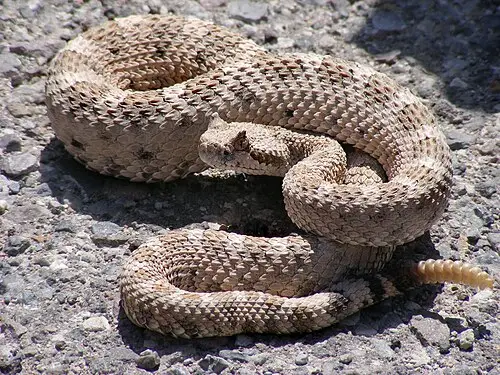
 📸 Photo
Photo: derivative work: Victorrocha ( talk · contribs ) Crotalus_cerastes_mesquite_springs_CA.JPG : Tigerhawkvok ( talk · contribs ) · CC BY-SA 3.0 · Wikimedia Commons Source
Sidewinder
Crotalus cerastes (Sidewinder · ヨコバイガラガラ)
💡 Everyday Comparisons for Size, Mass & Speed
- 💡 Its average weight of 250 g is lighter than a standard beverage can (about 355 g) (Comparison).
- 💡 Prey items listed in Animal Diversity Web include animals that live near people, such as house mice and house sparrows.
Reference standards: coach bus ~12 m, mid-size car ~4.9 m, compact car ~1 t, basketball hoop 3.05 m, credit card 8.56 cm.
Site-computed relative index from recorded values; not a formal scientific metric.
📖 1. Overview
The Sidewinder is a small rattlesnake living in sandy terrain of warm deserts, featuring horn-like raised scales above its eyes.
🦴 2. Anatomy & Morphology
Because of the horn-shaped scales above its eyes, it is also called the horned rattlesnake, and its tail rattle gains a segment each time it sheds its skin. Females grow slightly larger than males.
🔍 3. Ecology & Behavior
Lizards make up more than half of its diet, along with rodents and birds. It uses sideways "sidewinding" movement to minimize contact with hot sand, and males travel an average of about 185 m per day in search of mates.
🇰🇷 4. Connection to Korea
No direct record connecting this species to Korea has been found.
📚 Sources & References
- • IUCN Red List LC (2007) — https://www.iucnredlist.org/species/64315/12764960
- • IUCN Red List category LC — latest assessment at iucnredlist.org
- • catalogueoflife.org — ZPB7
- • iucnredlist.org — 12764960
- • wikidata.org — Q1366532
- • commons.wikimedia.org — File:Crotalus cerastes mesquite springs CA-2.jpg
- • animaldiversity.org — Crotalus cerastes
- • Silhouette: PhyloPic — Gabriela Palomo-Munoz · CC BY 4.0 (Congeneric silhouette — Crotalus atrox)
Recorded dimensions are widely cited representative estimates from public literature and may vary by study or specimen.