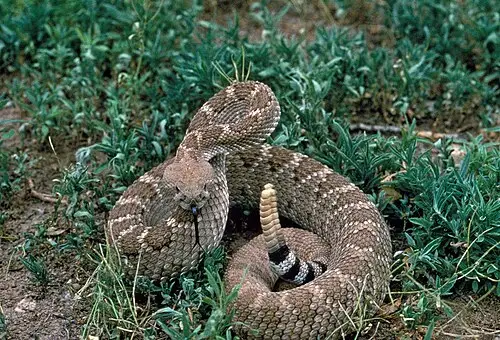
 📸 Photo
Photo: Gary Stolz (original) · Public domain · Wikimedia Commons Source
Western Diamond-backed Rattlesnake
Crotalus atrox (Western Diamond-backed Rattlesnake · ニシダイヤガラガラヘビ)
💡 Everyday Comparisons for Size, Mass & Speed
- 💡 Its maximum mass of 6.7 kg is about 2/3 of a 10 kg bag of rice (Comparison).
- 💡 Animal Diversity Web notes that although it causes more fatalities than any other snake in the United States, it helps control rodents, its skin is used for shoes and belts, and live snakes are used in snake shows and zoo education.
Reference standards: coach bus ~12 m, mid-size car ~4.9 m, compact car ~1 t, basketball hoop 3.05 m, credit card 8.56 cm.
Site-computed relative index from recorded values; not a formal scientific metric.
📖 1. Overview
The Western Diamond-backed Rattlesnake is a large rattlesnake living in dry, rocky scrublands, with a thick body and a rattle at the tip of its tail.
🦴 2. Anatomy & Morphology
It has a plump body, a short tail, and a broad triangular head. Between the eye and nostril lies a heat-sensing pit about 5 mm deep, and each segment of the tail rattle is a remnant of shed skin left behind at each molt.
🔍 3. Ecology & Behavior
It mainly preys on small mammals and birds, and occasionally takes other reptiles, amphibians, fish, and invertebrates. Its rattle vibrates 40–60 times per second as a warning, and it gives birth to 10–20 young via eggs that hatch inside the body.
🇰🇷 4. Connection to Korea
No direct record connecting this species to Korea has been found.
📚 Sources & References
- • IUCN Red List LC (2007) — https://www.iucnredlist.org/species/64311/12763519
- • IUCN Red List category LC — latest assessment at iucnredlist.org
- • catalogueoflife.org — 6BJ5K
- • iucnredlist.org — 12763519
- • wikidata.org — Q222287
- • commons.wikimedia.org — File:Crotalus atrox USFWS.jpg
- • animaldiversity.org — Crotalus atrox
- • Silhouette: PhyloPic — Gabriela Palomo-Munoz · CC BY 4.0
Recorded dimensions are widely cited representative estimates from public literature and may vary by study or specimen.