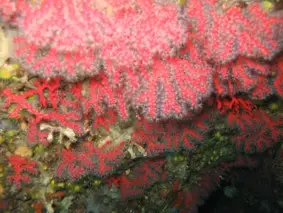
 📸 Photo
Photo: Marco Busdraghi · CC BY 2.5 · Wikimedia Commons Source
Red coral
Corallium rubrum (Red coral · 宝石サンゴ)
Not Evaluated (NE) on the IUCN Red List yet.
💡 Everyday Comparisons for Size, Mass & Speed
- 💡 The fact that its skeleton can exceed 50 cm means it can grow much longer than the long side of an A4 sheet of paper (29.7 cm) (Comparison).
- 💡 It is harvested commercially, and due to overharvesting, large colonies over 20 cm tall are disappearing (SeaLifeBase).
Reference standards: coach bus ~12 m, mid-size car ~4.9 m, compact car ~1 t, basketball hoop 3.05 m, credit card 8.56 cm.
📖 1. Overview
Red coral is a coral that lives attached to rocky cliffs and cave walls in the eastern Atlantic and the Mediterranean. It is a commercially harvested species.
🦴 2. Anatomy & Morphology
It forms a tree-like colony branching in all directions, and its hard calcareous skeleton is usually red. The polyps are about 1.5 mm in diameter, white and translucent, and the surface is not smooth.
🔍 3. Ecology & Behavior
It lives attached under dimly lit rock overhangs, on cave walls, and on deep cliffs. At high water temperatures above 24 °C, polyp activity and skeleton formation decline, often leading to mortality.
🇰🇷 4. Connection to Korea
No direct record connecting this species to Korea has been found.
📚 Sources & References
- • IUCN Red List: not evaluated (NE) — cross-checked with the Wikidata conservation-status entry
- • marinespecies.org — aphia.php
- • wikidata.org — Q531601
- • commons.wikimedia.org — File:Corallo vivo.jpg
- • sealifebase.se — Corallium-rubrum.html
- • Silhouette: PhyloPic — author not recorded · CC0 1.0
Recorded dimensions are widely cited representative estimates from public literature and may vary by study or specimen.