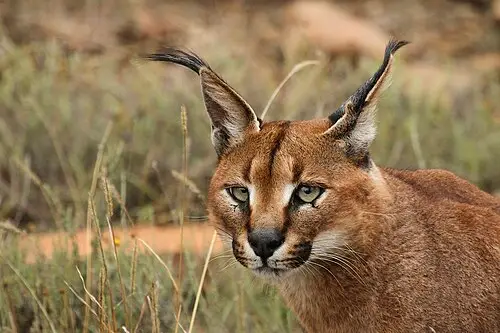
 📸 Photo
Photo: Leo za1 · CC BY-SA 3.0 · Wikimedia Commons Source
Caracal
Caracal caracal (Caracal · カラカル)
💡 Everyday Comparisons for Size, Mass & Speed
- 💡 Its maximum weight of 19 kg is nearly equal to a 20 kg bag of rice, and its length of 1.25 m is about the height of a lower-grade elementary school child (Comparison).
- 💡 In India and Persia, caracals were trained to catch game birds and deer, while in western and central Africa their bushmeat and pelts provide food and modest income for local people (ADW).
Reference standards: coach bus ~12 m, mid-size car ~4.9 m, compact car ~1 t, basketball hoop 3.05 m, credit card 8.56 cm.
Site-computed relative index from recorded values; not a formal scientific metric.
📖 1. Overview
The caracal is a medium-sized wild cat living in Africa and Asia. It favors forest-grassland edges and tolerates drier conditions than the serval.
🦴 2. Anatomy & Morphology
Its brown-to-red coat has a white underside dotted with many small spots. Its most distinctive feature is its long ears tipped with black hair tufts. It has long legs, well-muscled hind limbs, and a short tail.
🔍 3. Ecology & Behavior
It preys on hyraxes, hares, rodents, antelopes, small monkeys, and birds (doves and partridges). Solitary and mainly nocturnal in its hunting, it has even been known to chase off predators twice its size.
🇰🇷 4. Connection to Korea
No direct record connecting this species to Korea has been found.
📚 Sources & References
- • IUCN Red List LC (2016) — https://www.iucnredlist.org/species/3847/102424310
- • IUCN Red List category LC — latest assessment at iucnredlist.org
- • mammaldiversity.org — 1005981
- • iucnredlist.org — 102424310
- • wikidata.org — Q30847
- • commons.wikimedia.org — File:Caracal Caracal-001.jpg
- • animaldiversity.org — Caracal caracal
- • Silhouette: PhyloPic — Margot Michaud · CC0 1.0
Recorded dimensions are widely cited representative estimates from public literature and may vary by study or specimen.