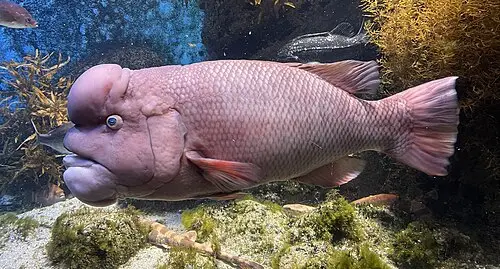
 📸 Photo
Photo: Totti · CC BY-SA 4.0 · Wikimedia Commons Source
Asian sheepshead wrasse
Bodianus reticulatus (Asian sheepshead wrasse · Asian sheepshead wrasse)
Not Evaluated (NE) on the IUCN Red List yet.
💡 Everyday Comparisons for Size, Mass & Speed
- 💡 Its maximum length of 1 m is the length of a 1 m ruler (Comparison).
- 💡 Its maximum weight of 14.7 kg is about three-quarters of a 20 kg bag of rice (Comparison).
- 💡 It is eaten raw or grilled, though it is said to be less tasty (National List of Species of Korea).
Reference standards: coach bus ~12 m, mid-size car ~4.9 m, compact car ~1 t, basketball hoop 3.05 m, credit card 8.56 cm.
Site-computed relative index from recorded values; not a formal scientific metric.
📖 1. Overview
The Asian sheepshead wrasse is a large wrasse living in rocky areas, named in Korean for the prominent hump that rises on the forehead of adult males. It is one of the largest species of wrasses.
🦴 2. Anatomy & Morphology
Its body is an elongated oval with a pointed snout and reddish-brown color. Mature males develop a large fat-filled hump on the forehead and a swollen lower jaw, whereas females do not have a hump.
🔍 3. Ecology & Behavior
It feeds on mollusks such as abalones and turban shells, as well as shrimp, sea urchins, and crabs. All individuals first grow up as females and transition into males over several years; a male establishes a territory with a harem of several females and spawns from spring to summer.
🇰🇷 4. Connection to Korea
According to the National List of Species of Korea, it lives in the South Sea, Jeju Island, and the southern East Sea, is caught year-round, and is used raw or grilled, though its taste is considered inferior.
📚 Sources & References
- • IUCN Red List: not evaluated (NE) — cross-checked with the Wikidata conservation-status entry
- • catalogueoflife.org — KV327
- • 국가생물종목록(국립생물자원관) ktsn 120000058781 — https://species.nibr.go.kr/home/mainHome.do?cont_link=009&subMenu=009002&contCd=009002&ktsn=120000058781
- • wikidata.org — Q141570628
- • fishbase.se — Bodianus-reticulatus.html
- • species.nibr.go.kr — mainHome.do
- • Silhouette: PhyloPic — author not recorded · CC0 1.0 (Related taxon silhouette — Anampses caeruleopunctatus)
Recorded dimensions are widely cited representative estimates from public literature and may vary by study or specimen.