 📸 Photo
Photo: No machine-readable author provided. Ltshears assumed (based on copyright claims). · Public domain · Wikimedia Commons Source
Gaboon Viper
Bitis gabonica (Gaboon Viper · ガボンアダー)
💡 Everyday Comparisons for Size, Mass & Speed
- 💡 Its fangs of about 5 cm are roughly the length of a matchbox (Comparison).
- 💡 The Smithsonian National Zoo notes that it has a placid nature and rarely bites, with most bites happening when someone steps on the snake before it can move away.
Reference standards: coach bus ~12 m, mid-size car ~4.9 m, compact car ~1 t, basketball hoop 3.05 m, credit card 8.56 cm.
Site-computed relative index from recorded values; not a formal scientific metric.
📖 1. Overview
The Gaboon Viper is a viper living in the leaf litter of African tropical rainforests and is the largest of the vipers.
🦴 2. Anatomy & Morphology
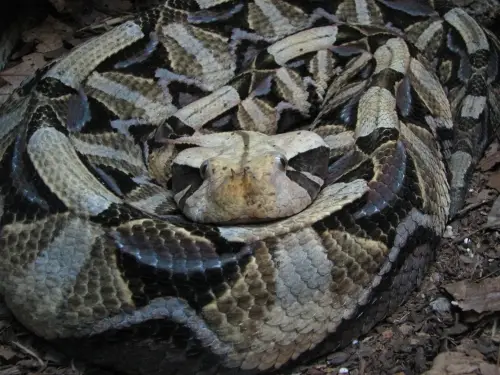
It has a triangular head with horns on the tip of its nose, a head about 12.7 cm wide, and fangs about 5 cm long. Its diamond and stripe pattern of brown, pink, and purple camouflages it to look like fallen leaves.
🔍 3. Ecology & Behavior
At night it waits motionless in hiding before striking small mammals such as rodents, ground-foraging birds, frogs, and toads. Females carry their young internally for 7 months and give birth to 30–40 live young at a time.
🇰🇷 4. Connection to Korea
No direct record connecting this species to Korea has been found.
📚 Sources & References
- • IUCN Red List VU (2021) — https://www.iucnredlist.org/species/13300893/13300904
- • IUCN Red List category VU — latest assessment at iucnredlist.org
- • catalogueoflife.org — LXL7
- • iucnredlist.org — 13300904
- • wikidata.org — Q371183
- • commons.wikimedia.org — File:GaboonViper.jpg
- • animaldiversity.org — Bitis gabonica
- • nationalzoo.si.edu — gaboon-viper
- • Silhouette: PhyloPic — Beth Reinke · CC0 1.0 (Related taxon silhouette — Vipera berus)
Recorded dimensions are widely cited representative estimates from public literature and may vary by study or specimen.