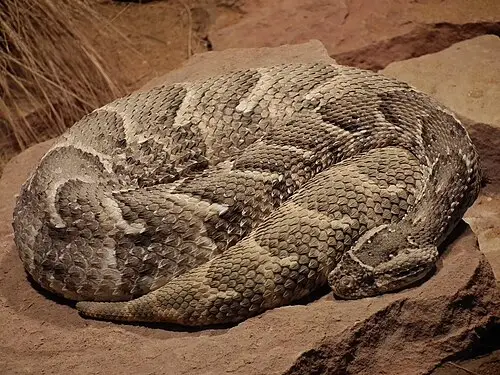
 📸 Photo
Photo: 4028mdk09 · CC BY-SA 3.0 · Wikimedia Commons Source
Puff Adder
Bitis arietans (Puff Adder · パフアダー)
💡 Everyday Comparisons for Size, Mass & Speed
- 💡 Its maximum weight of 6.8 kg is about the weight of a large watermelon (Comparison).
- 💡 Animal Diversity Web notes that the Puff Adder reduces crop damage by catching rodents and that its venom is worth studying for potential medical uses.
Reference standards: coach bus ~12 m, mid-size car ~4.9 m, compact car ~1 t, basketball hoop 3.05 m, credit card 8.56 cm.
Site-computed relative index from recorded values; not a formal scientific metric.
📖 1. Overview
The Puff Adder is a thick-bodied, short viper widely distributed across the African continent from Senegal to South Africa.
🦴 2. Anatomy & Morphology
It has a heavy body and a thick, triangular head, with folding fangs about 5 cm long that inject potent venom preventing blood from clotting. Its earth-toned pattern lets it blend into grasslands.
🔍 3. Ecology & Behavior
It is a solitary ambush hunter that lures prey with its tail or tongue, feeding mainly on rodents while also catching reptiles, birds, frogs, and small deer. When threatened, it hisses loudly and puffs up its body, giving the species its name.
🇰🇷 4. Connection to Korea
No direct record connecting this species to Korea has been found.
📚 Sources & References
- • IUCN Red List LC (2021) — https://www.iucnredlist.org/species/197461/2485974
- • IUCN Red List category LC — latest assessment at iucnredlist.org
- • catalogueoflife.org — LXKX
- • iucnredlist.org — 2485974
- • wikidata.org — Q369667
- • commons.wikimedia.org — File:Bitis arietans 2010.JPG
- • animaldiversity.org — Bitis arietans
- • nationalzoo.si.edu — puff-adder
- • Silhouette: PhyloPic — Beth Reinke · CC0 1.0 (Related taxon silhouette — Vipera berus)
Recorded dimensions are widely cited representative estimates from public literature and may vary by study or specimen.