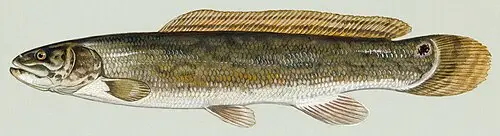
 📸 Photo
Photo: Duane Raver/U.S. Fish and Wildlife Service · Public domain · Wikimedia Commons Source
Bowfin
Amia calva (Bowfin · アミア・カルヴァ)
💡 Everyday Comparisons for Size, Mass & Speed
- 💡 A maximum length of 109 cm is 9 cm longer than a 1 m ruler (comparison).
- 💡 A maximum weight of 9.8 kg is similar to a single 10 kg sack of rice (comparison).
- 💡 Its flesh is pasty and not eaten for food, but anglers enjoy catching it for its strength, and its roe has been sold as an inexpensive caviar substitute under the name 'Choupiquet Royal' (Animal Diversity Web).
Reference standards: coach bus ~12 m, mid-size car ~4.9 m, compact car ~1 t, basketball hoop 3.05 m, credit card 8.56 cm.
Site-computed relative index from recorded values; not a formal scientific metric.
📖 1. Overview
The bowfin is a freshwater fish capable of breathing air, living in swamps, lakes, and slow river backwater pools of North America. It can endure for long periods even in mud after water has drained.
🦴 2. Anatomy & Morphology
It has a very large gular plate between the lower jaws on the underside of the head, and a dorsal fin so long that it spans 42–48% of the body length. The pectoral fins are large and rounded.
🔍 3. Ecology & Behavior
An indiscriminate predator eating insects, fishes, crustaceans, and frogs, it swallows prey by suction created by opening and closing its mouth in 0.075 seconds. Capable of air-breathing, it has been recorded surviving for 21 days in the mud of a drained pond.
🇰🇷 4. Connection to Korea
No direct record connecting this species to Korea has been found.
📚 Sources & References
- • IUCN Red List LC (2013) — https://www.iucnredlist.org/species/201942/2730796
- • IUCN Red List category LC — latest assessment at iucnredlist.org
- • catalogueoflife.org — CRZ7
- • iucnredlist.org — 2730796
- • wikidata.org — Q491934
- • commons.wikimedia.org — File:Amia calva1.jpg
- • fishbase.se — Amia-calva.html
- • animaldiversity.org — Amia calva
- • Silhouette: PhyloPic — Duane Raver (vectorized by T. Michael Keesey) · Public Domain Mark 1.0
Recorded dimensions are widely cited representative estimates from public literature and may vary by study or specimen.