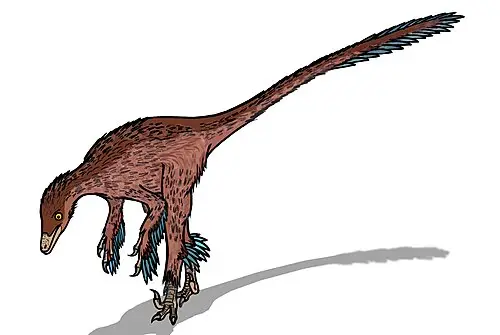
 🎨 Restoration
Restoration: Conty · CC BY 3.0 · Wikimedia Commons Source
Life restorations are artistic reconstructions based on fossil evidence; true coloration and soft-tissue details remain uncertain.
Troodon
Troodon formosus (Troodon · Troodon)
Known only from fossils. The IUCN Red List assesses only species extant since 1500 CE, so fossil taxa are not assigned a category.
💡 Everyday Comparisons for Size, Mass & Speed
- 💡 The name was based on a single tooth fossil described in 1856, and today only that tooth is strictly referred to Troodon—an example of a dinosaur named from a single tooth.
- 💡 The idea that it ate both meat and plants makes its diet comparable to human omnivory (Comparison).
Reference standards: coach bus ~12 m, mid-size car ~4.9 m, compact car ~1 t, basketball hoop 3.05 m, credit card 8.56 cm.
📖 1. Overview
Troodon formosus (genus Troodon) was a small theropod from the Late Cretaceous of North America, and its name means 'wounding tooth.' Most fossils once called by this name are now referred to Stenonychosaurus.
🦴 2. Anatomy & Morphology
It walked on two legs and had short, serrated teeth. The shape of its teeth resembled that of some plant-eating animals.
🔍 3. Fossil Record & Paleoecology
Because of the shape of its teeth, it is thought to have been an omnivore that ate both meat and plants. Claims about its high intelligence were based on braincases now assigned to another genus.
🇰🇷 4. Connection to Korea
No direct record connecting this species to Korea has been found.
📚 Sources & References
- • Fossil taxon — the IUCN Red List assesses only species living or extinct since 1500
- • paleobiodb.org — basicTaxonInfo
- • wikidata.org — Q22112910
- • commons.wikimedia.org — File:Troodon formosus (feathers).JPG
- • nhm.ac.uk — troodon.html
- • Silhouette: PhyloPic — Raven Amos · Public Domain Mark 1.0
Recorded dimensions are widely cited representative estimates from public literature and may vary by study or specimen.